Thursday, 15 November 2012

Golden news

The recent weeks have seen a series of archaeological news in the national or international arena. These news do not have much common – naturally, apart from being the results of an archaeological digs. We have seen gold from Bulgaria, mammoth bones from France and a giant from Rome. The most glittering of these is of course – both literately and actually – are the golden objects from a tomb in Bulgaria. These Thracian finds have promptly connected with Alexander the Great. It seems to be all in the family!


One of Thracian objects (link to Daily Mail Online)

The site of the ancient Getic burial complex, in the past area of the Gaths, situated near the village of Sveshtari, approximately 400 kilometres northeast from Sofia. The gold came from the largest of 150 burials. These finds could be, as suggested by Diana Gergova, the chief archaeologist at the site, related to the funeral of the Gath ruler Kotela, one of the father-in-laws of Philip II of Macedon, Alexander the Great's father. It seems the lure of finding the known named persons from the past is alive and well.


Digging 'Helmut'

The mammoth was found near Paris in France while the archaeologists were excavating ancient Roman remains in a quarry near the town of Changis-sur-Marne. The mammoth has been promptly named ‘Helmut’. Mammoth finds are not that rare; the distribution and extinction of this animal has been studied with the finds from Scandinavia and Estonia and Helmut was the fourth almost full mammoth skeleton from France alone. However, Helmut was definitely in contact with humans as suggested by the flint implements found at the same location. Two tiny flint flakes were found among the bones indicating that cavemen cut into the body, but clearly did not kill the animal with these pieces. Nevertheless, these finds are evidence of mammoth – human interaction 100 000 – 200 000 years ago. The chief archaeologist Gregory Bayle says: “We're working on the theory that Neanderthal men came across the carcass and cut off bits of meat.”


A bone with gigantism from Fidenae (by Simona Minozzi, Endocrine Society)

National Geographic has published the oldest skeleton find with gigantism, the condition that makes the sufferer to grow into a considerable height. The skeleton was excavated already in 1991 from Fidenae, one of the modern suburbs of Rome that was the location of one Archaic Latin cities. This skeleton has only been properly studied recently. Nevertheless, this area had a considerable rural settlement in the Roman period and as it was located on the Via Salaria its probable roadside or villa location was a natural choice for a Roman cemetery. He was 202 cm tall – approximately 35 cm taller than his average contemporaries in the 3rd century AD.

These are all exotic, attractive finds that feed anyone’s imagination. However, there is a serious scientific content with each news item, be it the interregional contacts between the Mediterranean and the other areas, the human – animal interaction or the history of human pathology. In these days Twitter and Facebook deliver the news even wider than the traditional newspapers and broadcasting companies. While trying to find out, if Priddy Circles had been discussed in Twitter, I found a plethora of retweeted tweets with the Roman giant instead.


Mammoths in Sweden: Ukkonen, L. Arppe, M. Houmark-Nielsen, K.H. Kjær, J.A. Karhu: ‘MIS 3 mammoth remains from Sweden—implications for faunal history, palaeoclimate and glaciation chronology’, Quaternary Science Reviews, Volume 26, Issues 25–28, December 2007, 3081–3098
Mammoths in Estonia: Lougas, P. Ukkonen, H. Junger: ‘Dating the extinction of European mammoths: new evidence from Estonia’, Quaternary Science Reviews, Volume 21, Issues 12–13, July 2002, 1347–1354

Thursday, 8 November 2012

The draw of places – the consecutive reuse of landscapes

A desktop study can reveal something different from the underlying archaeology that is only fully understood during an excavation. The Medieval earthworks at Eye Kettleby suggested Medieval activity in an area of designated development. These ‘humps and bumps’ had already been mapped in the field and from the air photographs in the 1980s, and large quantities of flints and Anglo-Saxon pottery were later recovered during a field survey in the 1990s. These finds suggested activities inside a wide period between Mesolithic and Bronze Age and a later possible Early-Middle Anglo-Saxon cemetery. Nevertheless, the main feature of the published excavation (Finn 2011) turned out to be ‘ceremonial’ enclosures defined by ditches with Bronze Age cremations and with an Anglo-Saxon settlement in the northern area. This shows how the expectation of find something typical, such as an Anglo-Saxon cemetery, defines the initial interpretation.


The area today in Google

The area is bordered in the south-west by a stream but the river Wreake runs farther in the north. The area was at the time of the excavation relatively flat, but there were indications that the carr in the west was filled in during the Medieval period in order to level the area. The flint finds representing the earliest intervention in the area corresponds to blade technology with a few mainly end scrapers dated roughly to the Mesolithic/Early Neolithic. Later layer of flints belong to the Neolithic/Early Bronze Age blade technology with a higher number of scrapers and retouched flakes. Most of the flint finds from the carr were debitage, but there was a Neolithic flint axe, of orange flint and probably exotic, which could have been deposited with intention.

There were a couple of Neolithic pits but the main feature was four enclosures, two round ones and two oval ones. The circular enclosures were in the middle and those oval ones on both sides creating a somewhat elongated shape. The cremations concentrated inside the enclosures. The scientific dates of the Early Bronze Age cemetery are around 2100 and 1800 BC. The circular enclosures do remind ring ditches around the barrows in Leicestershire as is pointed out by Finn. The site was reused as an ‘Urnfield’ cemetery at a slightly later date towards the Middle Bronze Age with 8 separate groups of cremations. Some of these were between the enclosures, some farther away and three groups inside three of four enclosures. The oval one in the east remained empty. The dates from the urned cremations hover around 1500-1600 BC with a wider spread with the unurned ones.

During the Late Bronze Age the site was in both settlement and funerary use. There were pit alignments with animal bones to create boundaries into the area, which had signs of houses with ditches and post-holes and a hearth pit. The Late Bronze Age finds included a socketed bronze axe, spindlewhorl and loomweights. This earlier ceremonial space was at least partly truly domesticated at this point.

The monumental enclosures here did not lie in isolation but as part of a busy Bronze Age landscape with ring ditches and barrows dotting the Eye/Wreake river valley, not to mention flint scatters and possible Late Bronze Age settlements. Interestingly, there is a pit with a considerable deposit of fired clay and pottery that suggests that the destruction of the Late Bronze Age building was deliberate. Brück has suggested that the short-lived settlements were a sign of generational shift. At least these signs of deliberate dismantling are more common than just present there at Eye Kettleby.


Finn, N., 2011.Bronze Age Ceremonial Enclosures and Cremation Cemetery at Eye Kettleby, Leicestershire. Leicester Archaeology Monograph 20.


This site in the online databases:
Heritage Gateway (multiple records)
Archaeology Data Service

Thursday, 1 November 2012

Priddy Circle verdict: how much is a monument worth?

This week brought the sentencing of the case of the partial destruction of one of the Priddy Circles in the Mendips in Somerset. A retired businessman who had bought the farm house near the Circles had hired a contractor to do some building work across one of the monuments. This work led to the partial filling and destruction of one of the Circles. This week the landowner was ordered to pay up to £37,000 for restoration work, given a fine of £2,500 and told to pay legal costs of £7,500.


'Bulldozed' Priddy circle (photo from Telegraph)

How has the archaeological community responded to this sentence? RESCUE has not notified this news on its web page. BAJR does not have it in its archaeology news even if the actual destruction can be found through their search engine in the Past Horizons blog (under English Heritage). Neither is this news on the news page of the Council of British Archaeology or English Heritage. English Heritage has released a press release, though, flagged elsewhere in the blogosphere. I was unable to find it on the English Heritage web pages. I myself noticed the news from that always reliable archaeological source – the Daily Mail Online. It has also been notified by the local paper in Somerset.

Heritage Action blog has dissected the verdict and referred to the EH press release. Their verdict of the verdict is that the fine for destroying a unique Neolithic monument was a joke. They refer to a recent sentence were a fine of £2,600 was handed for installing uPVC windows in a listed farmhouse. It is clear that even if there is a price for the restoration work, the scale of sentencing was lenient – considering the relative wealth of the guilty party. English Heritage states that "English Heritage is very pleased that Mr Penny has agreed to pay for repairs to the monument and other mitigation works at a cost of around £38,000... ...In sentencing the judge was clear that had it not been for Mr Penny’s agreement to pay these substantial mitigation costs, the fine would have been significantly higher".

The judge considered the cooperation of the accused throughout the process a factor that led to a more lenient sentence and lower fine. English Heritage is happy with this verdict as a showcase that they "can and will prosecute in cases of serious damage and unauthorised works to Scheduled Monuments". English Heritage considers as a positive sign the recognition from the part of the defendant and the court that the Priddy Circles are of great importance and that they agree that this was a serious offence.

Is £2,500 a lot? The damaged section is perhaps one quarter of the area of one circle. There are four Priddy Circles, and thus, the damage was done to a 1/16 of the Circles. The site has been compared to the Stonehenge and if this can be taken for face value, one could cheekily suggest that serious damage to Stonehenge might result with a fine of £40,000 – if the accused shows remorse and agrees that Stonehenge is of great importance. And the sum would only be this high, if the damage would cover all parts of the monument...

Thursday, 25 October 2012

University landscapes

Universities seem to mingle and intertwine with their surroundings in different ways. Many older universities concentrate in certain areas and have central buildings but are ultimately integrated to the fabric of the cities where they are located. This is true for example with the Universities of Bologna, Groningen and Helsinki. Some towns ARE basically universities, such as Cambridge or Oxford, that are synonymous with their universities, even if there are other higher education facilities in these cities.


Bologna

Many universities have separated campuses, either physically in a different location outside urban area, as Keele or Birmingham are. Some of these campuses are engulfed by the city, but separated by a wall, as is “La Sapienza” at Rome. Some newer universities are slotted in different locations and are actually more regional outlets, like the other Cambridge University the Anglia Ruskin with a second campus in Chelmsford. Then, there is the Open University that may engage its students remotely, but has very physical locations at Milton Keynes and different regional centres. Good old-fashioned buildings in brick and mortar.

It is easy to recognize that the main building of the University College London is special and the Cambridge and Oxford colleges represent different modes of college building. In one city the buildings is more open and in the other more fortress-like, but they both are clearly buildings with a certain function, easy to classify apart, even if one was a Martian on one’s first trip on the Earth.


University Library, Cambridge

Nevertheless, no matter how much different universities try to move their libraries online, rationalise their collections, introduce cafeteria and retail areas and cut the book spending, a feature that epitomises scholarly research is a library. Even if I have passed there many times, the long, narrow corridors of the University Library at Cambridge still impress me with the sheer number of books and nothing makes you feel more like a real scholar than sitting on one of the chairs in the main reading room of the American Academy in Rome, when the windows are open with the early summer wind blowing through and you are tapping away with your laptop. The same awe of surroundings and the situational appropriateness fills you in the Bodleian Library. This does make a university a mental place, but defined by the physicality of its buildings and surroundings - not to mention its objects.

Thursday, 18 October 2012

Community archaeologist has gone – long live community archaeology!?

It is somewhat ironic that the surge in job placements in archaeology in community archaeology is a simultaneous development with the disappearance of the dedicated community archaeologist post in Leicestershire. Throughout the eighties, nineties and noughties Leicestershire county council gave support to local groups so that local communities could come together and study the past of their villages. Community archaeologist gave training to volunteers, paid visits to different groups in order to check the finds and teach the members to recognize different materials and provided materials in order to record and storage the finds. These were deposited to the local museum for safekeeping.

Community archaeology has not completely disappeared from Leicestershire but the remit has been joined with the other duties of the county council’s museum service archaeologist. With the new round of savings coming and such measures discussed as the ‘temporary’ closure of the Market Harborough Museum, it is questionable how the new archaeology officer has time apart from an occasional visit to see one of the larger and more active excavating groups in action or help with the deposition of the most important finds together with some general communication duties. After all, the new officer is also responsible for all the collections that are presented in different museums from Snipston to Charnwood and Market Harborough to Melton Mowbray. One person cannot do all – and there is the Festival of Archaeology coming up every year, too!

Nevertheless, the local community archaeology and fieldworking groups have a first class asset in Leicestershire Fieldworkers. Nor has Peter Liddle left archaeology, but he works as a freelancer. The severance of the permanent link with the county council and the financial benefit it brought means that the ways of communication between fieldworkers are changing towards e-mail and internet-based interaction, whereas previously the newsletter was posted to every member. This new situation also means that the groups have to take greater responsibility over their activities and probably also deal with the cost. The Fieldworkers as an organisation guarantees – at least as long the current chairman and Peter Liddle are active – the support the groups need and a way to provide professional assistance to the groups in order to guarantee that the high-quality work continues.

Friday, 12 October 2012

The way we live today

After getting an offer on Phil’s Victorian terraced house we have been looking at the properties and visited a series of homes locally, mainly in different local estates. Naturally, coming from abroad, my perception of normal family home is somewhat different from a normal English one since I did live in apartments all my life in Finland. A flat with a living room, a kitchen and a couple of bedrooms together with a balcony was what I and my friends called a home. Many people aspired buying a plot of land and ‘building’ their own homes – or purchasing a detached house package from one of the providers – something my brother is doing right now. My dream home was in one of the early 20th century stone town apartment blocks with their high ceilings and Jugend/Art Nouveau features.


Your average new development

In recent weeks I have seen a series of detached or semi-detached houses with a living room and a dining area behind in front of the patio windows. You could not have patio windows in the northern climates where you could only have a proper large window and a door next to it with proper insulation. Then it is upstairs to the three bedrooms and the pokeyish family bathroom. Some of the boxrooms are decent but some have the stairwell eating into the room with all kinds of shelf and cupboard solutions built on top of them. The standard living space seems often small and these houses suddenly have made the Victorian pokiness seem less so.

The newer the estate the smaller the gardens. Some of the plots are ridiculously small, when you consider these houses were meant to be family homes from the beginning. The fences have to be relatively low in order to allow sun properly onto the small plots, so you will get to know your neighbours in these locations. In some estates there is a huge front garden, mostly taken up nowadays by car bays. In one front garden there were two white vans and a normal car. In these cases the front space is in good use, but sometimes you wonder, if a larger proper garden or a larger house could have been a better solution.

Then there are the garages. They are not used as garages anymore but feature freezers, washing machines and extra dressers and cupboards together with all kinds of clutter. The modern houses are clearly too small, when the things we really need do not fit in into their small kitchens. Some of the dining areas can hardly fit a table for six and can feel claustrophobic, if the large patio doors lead to a very small garden. All the light but no space.

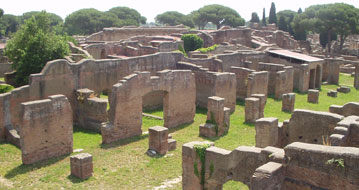
This economic use of space is nothing new. Already the Romans were building type houses and blocks and flats with repeated floor plans. The ancient Ostia has plenty of these buildings that can be explored by modern visitors. These rooms seem to have been relatively dark, although this is sometimes difficult to clarify due to the partial preservation of the remains. The large villas and town houses were lavish and spacious, but the flats could be very pokey. Money talks – and did talk.

Thursday, 4 October 2012

Coins in a context

The Hallaton treasure gives us an unparallel insight into the deposition of coin hoards, even if it presents a special case with the late Iron Age shrine it is connected with. Vicki Score (2011) and a series of specialists have published lately a full volume to present different aspects of the hoard. Even if it is clear that more cartographic presentations and reconstructions will follow taken the emphasis on textual representation in presenting the context and interpretations, the volume shows us how the coins entered into the treasure.


Iron Age coins from Hallaton Treasure

Approximately 64 % of the coins originated from properly excavated stratified contexts. Out of over 5000 coins only 149 were Roman and 116 from other Iron Age areas outside north-east Corieltavi. Most stratified finds were related to an entranceway or to the Roman helmet. The latest Roman coins struck were from early Imperial period from the reign of Emperor Claudius AD 41/42. This confirms the exceptional nature of these deposits originating from a time when ‘the Romans were coming’.

The excavators could count 14 separate hoards in the entranceway area, several of them in clustered appearance, clearly been put into ground in ‘purses’. The make-up was very similar and the coins came from the same circulation pool. They were deposited over an extended period but Leins in the volume assumes they were buried in c. AD 43-50, during the early post-conquest period when the East Midlands was falling under the Romans. The coins buried with the helmet, presenting two different areas of deposition, nevertheless seem to form a single act of deposition. There was a discreet group of coins in the north-eastern part of the helmet pit but there was a number of coins alongside the helmet. The chronological distribution of the helmet coins was consistent with the reign of Emperor Tiberius.

In comparison, only a tiny number of coins came from ditches or other contexts. However, the composition of the ditch contexts was different with 50 % of coins being unstruck early types. These coins represented only a few percent of the entranceway or helmet deposits. There were other metal objects from the ditch, including a silver bowl and silver and silver and copper alloy ingots. The ditch deposits were partly destroyed by a land drain so a detailed reconstruction of the ditch fill contents is not possible.

The general trends in chronological composition were very similar, if not identical to the Scole and Warmington hoards. However, the Hallaton distribution peaks at 89-80 BC that is considered peculiar to the site. A number of coins from the stratified contexts and especially from unstratified ploughsoil are from later Roman periods. There were coins from the Flavian period and the reigns of Trajan and Hadrian but a higher number from the late Roman times, especially the late 4th century AD. These finds seem to avoid the Iron Age ritual area, though.


The Hallaton promontory hillock overlooking the rivervalley

The coin deposits follow different logics. The early ditch deposits were lying on the left-hand side when going in, whereas the entranceway deposits were on the left-hand side when going out. In addition, the feasting deposits were buried outside the boundary. Score suggests a social distinction between the participants inside and outside. The location of many of the hoardsites near the hilltops suggest that the rituals were highly visible to those who were not directly participating in the acts.


Score, V., 2011. Hoards, Hounds and Helmets. A conquest-period ritual site at Hallaton, Leicestershire. Leicester Archaeology Monograph 21.