Friday, 27 September 2013

About Frontiers

Last weekend was all about frontiers – or at least boundaries or borders in the widest sense. The conference took place in Cambridge, but most of the subject matter was central Italian and related to the Frontiers of Etruria project Simon Stoddart is currently running. However, penultimate paper was about the afterlife of the Antonine Wall and what a rather splendid paper it was. It was fascinating to hear that after the withdrawal of the Romans behind the Hadrian Wall the use of Latin continued in the area between the walls even if the burial customs and such were similar across the whole Scotland mainland. Only later with the Christian church the Latin legacy reached other areas.

Not that the people knew what the humps and pumps running across to the narrowest stretch of land to the Forth to the Clyde was. It was just a general monument left by distant mythical creatures; only relatively recently archaeologists and historians could ascertain the character of the remains after the chance find of an inscription that mentioned the Emperor.

Most of the conference there were two sessions running on, so one could not hear or see everything. In addition, I and my husband were both presenting papers, so I spent some quality time with my son as well during the weekend. However, I managed to get my own goals covered and could ascertain that at least one of my research ideas is not covered by anybody else and the other will work to an extent. Only to an extent, since I was unaware how large field projects the Dutch team at Leiden is carrying out in the Apennines in order to study Latin colonies and their settlement patterns. Nevertheless, now I will able to streamline my own plan to a more realistic extent and do the core parts of my comparison of the Archaic and Late Republican occupation around Nepi.

The main result of the conference was that I seem to join the fine Finnish tradition of epigraphic research. Not that it is or was my primary aim, but the recently published studies make the epigraphic material an obvious choice when one wants to study cultural interaction in central Italy between the Archaic and Middle/Late Republican period. This relates to my promotion of the study of mental distances, e.g. relative closeness and distance between communities and groups in central Italy during the pre-Roman times. Now I have made the final touches to the article that presents this concept in its archaeological form to the reading academia; I think there is hope that the article and the volume it is part of will come out in the spring.


Tombs at Cerveteri

Nevertheless, some of the papers seem to support my suggestions. Frederik Tobin from Uppsala has found out that the tombs at San Giovenale presented architecture from both Tarquinia and Cerveteri. This suggest that either the tomb architecture is not as directly connected to the political power in the Etruscan past as it has been thought or that the communities in inner Etruria were not under strict rule of one of the large city-states on the coast, but could interact with and between them. Similarly, the material culture from the northern Faliscan area may suggest the same thing.

Monday, 23 September 2013

Free for this month!

Stockholm is full of wonderful museums and art galleries and I see as one of the perks of my stay here the possibility to revisit Kulturhuset, Medelhavsmuseet, Historiska Museet, Medeltidsmuseet and the Wasa ship. However, the problem arises on a Sunday after a busy period, when you do not really feel like be thoroughly inspecting the displays – as you should when you pay in order to get in.

I already had had a quick trip to the Kulturhuset, but those exhibitions were closed or closing, so there was not going to be anything new there. I knew that Medelhavsmuseet is not too taxing and the Cypriot collections are unusual outside the Cyprus itself. However, I was feeling like just tipping in and browsing a bit in a cultured surroundings.


Personalising Bronze Age burials

Luckily, before heading to the centre I checked the local free Metro and realised that Historiska Museet is under renovation and free for the whole September. It was interesting to see the totally new exhibition. Last time I had been in the museum, there was a traditional beginning and then a 1970s bright colours before the Viking highpoint at the end.

Now the exhibition was totally different. One of those displays where you have a lot of visiual ideas and a narrative that avoids archaeological jargon and tries to be as easily understandable as possible. The displays also tried to make the past approachable so that the individuals were brought to the front.

There were no specific culture names or distribution maps. The prehistory was presented as a series of personal stories and circumstances (a ritually killed and buried girl, a man with Roman contacts, an aristocratic woman from early Middle Ages) or specific sites. The problem was that since the period information was almost lacking, it was very difficult for a non-Swedish archaeologist to compare material to for example Finnish or Mediterranean material from equivalent periods. I did my courses in Scandinavian archaeology so long ago that it was impossible to use this exhibition as a quick refresher course.


Runestones

I really liked certain parts of the exhibition – such as the airport lounge with different gates with announcements to the past and mini-exhibitions discussing topics such as the use of the past in propaganda. However, I cannot understand why there were no maps. It would have been nice to see the distribution of the rune stones that were well displayed or something connecting Vendel tomb to the wider funerary landscape. Sometimes displays become so generic they almost use same universal characterisations from one period to another. Sometimes a few references to the Bell Beaker Culture could tell more about the past than very simply worded panels.

Friday, 13 September 2013

The power of words

During the first two weeks in Sweden I have managed to put together enough material in order to present a paper in the Frontiers in the Iron Age conference in Cambridge next week. I will undoubtedly return to the themes I will talk about when commenting on the conference in two weeks time. In any case, I have to prepare the material better before I publish anything, so this will be a longer research process for the future, but I have some interesting questions to discuss.

Alongside preparing this talk I went and listened other people giving talks. In Stockholm I heard in the researcher seminar an interesting talk about the classism in nation building in the 19th century Europe, delivered by Athena Leoussi, a sociologist from Reading. It was fascinating to hear that the English presented themselves as the successors of the ancient Greeks, the most racially advanced humans so far. This was because they considered themselves tall and blond Anglo-Saxons, belonging to a northern race similarly to the Scandinavians. The French on the other hand perceived the Greeks as splendidly dark and olive-skinned and saw themselves as the torchbearers of the Greeks of the southern France. Both ideologies had practical consequences with the emphasis on the beneficial effect of fresh air and sports. The English developed rugby whereas the French emphasized the importance of the Mediterranean sun and exercise. Then there were the Germans, but the talk contrasted the English and the French.


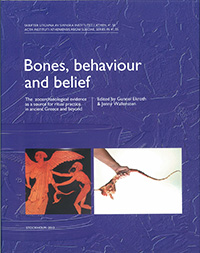
The cover (by J. Karydakis)

The other splendid event was the book publication at Uppsala. For a prehistorian, a book about zooarchaeology would not be anything unusual, but the scholars involved in classical studies have only recently realised on the basis of bone evidence that the reality of animal sacrifice and ritual customs and the related feasting is much more versatile and interesting than can only be understood by reading the texts. There is still a perception that the texts are paramount, but it is clear that the time is near when the archaeological material will be paramount when studying these themes in classical archaeology. Bones, behaviour and belief is a good start.

Thursday, 5 September 2013

Swedishness through time summarized in two bedrooms

Sometimes the interior spaces can define a national character and rarely more so than when I arrived to Sweden. I spent my first night in a B&B in the city centre where the furniture and decorations were very much in keeping with the 18th and early 19th century styles. This is the romantic intellectual royal past of wooden houses, wooden furniture, pastel colours and tiled fireplaces.

The other Sweden, more modern one, is summed up by the IKEA overload of my student flat. When black is the brightest colour of your own space, you know that you are living in a minimalistic flat. I do have a lovely view over the inner archipelago and I can see swaths of coniferous mixed forest from my window, not just modern blocks of flats and old villas from the turn of the 20th century.

This is Sweden – modern, efficient, affluent and cute. I can hardly wait to take a Finland ferry!

(To see the outer archipelago and the open sea)

Sunday, 1 September 2013

I have landed!

Just a quick note to say that I have been too busy to write my blog. I had to give a student who failed his essay a supervision in order to explain what will be required to make it better amongst the preparations for my son's first school day and writing and submitting quickly a grant application. Then I had to pack my most crucial notes and memory sticks together and spend my Sunday travelling to Sweden. After a long day I have arrived to a B&B where my room is from a 18th century classical dream. Nice wooden bed, tiled oven and soft colours. A bit of romanticism before heading to the Stockholm University tomorrow and getting the keys to my work-away-home pad in a student accommodation block,

I will have a year long contract with the university here and do my research in classical archaeology. I will undoubtedly also take part into the NTAG 2014 that will be here in Stockholm in April. It will be a year full of work and travelling between UK and Stockholm, but I hope it will be worth it. I hope to finish a series of publications within this time.

I hope to be more archaeological in my next posting when I have hopefully 'conquered' Skatteverket and found my way around the campus and the department.

Friday, 23 August 2013

Temporality of it all

The rare beach days this week reminded me how most of the everyday and special day activities we do do not leave any traces at all. The repetitive actions that the persons do purposefully for their own leisure may disappear in moments, be over in minutes and leave no trace. Some of these special landscapes are transient, such as the beach establishments. In some countries these have permanent structures, but in some places, such as Jersey, they are just rental services that pile their merchandise overnight under tarpaulin. In the morning they place their beach stretchers in pairs with or without an umbrella in order to lure the customers to take a seat in their comfort.


Sand castle being wiped away

Many of the families were making sand castles like we were and these castles were wiped out by the high tide. During the hours leading to the low tide the life guards and the surfing board and banana boat adventure renters kept moving their Jeeps and stacks of boards and kayaks nearer to the waterline. Not trace of these tracks were visible the following day and the narrow stretch that stayed above the water was covered by windblown dry white sand. You could see how the same meaningful actions were to follow each others partly by the same people and partly by the passing tourists from one day to the other.

This intentionality probably defines best the temporality as meant by Ingold in his seminal 1993 article. Our task will be by Christmas to define properly how this taskscape is different from any ceramiscene we have been discussing - even if the taskscape was one of the inspirations behind the ceramiscene as a concept. This example of temporality does show that my love for lazy beach days is not for vain!

Friday, 16 August 2013

Preparations, preparations

My long longed for holiday is almost here. Three nice days in the Channel Islands preceded by a visit to see the in-laws. I hope it will be sunny, so we can go and drive around the island and perhaps see some archaeology as well. I can only wonder how different events during this year have shaped my immediate future and changed my focus slightly after I did not get a local community archaeology placement.

I have suddenly realised that my next temporary step will be just two weeks away. For a year I will get a steady salary, but spend periods of time away from home. However, I have to make frequent visits in order to keep the family life going and probably to do some library work.

I am actually getting quite excited, since I will look at some new questions, while preparing old projects for a series of publications. I will be able to look at the issues of boundaries and population movements that will help me to see my old projects in a wider framework, slightly stepping out of my normal chronological boundaries. The discussions I am going to make are self-evident – so self-evident, I am surprised I did not realise to work on them earlier. However, it just proves how dangerous the period boundaries are for archaeological research, easily ghettoing researchers’ thinking. However, part of the landscape pondering will be so self-evident, it must have been written already millions of times. Nevertheless, I am likely to make a couple of newish comparisons and points by looking at the matters through the material from the Nepi survey.

I have started to use a library database in order to know what I will have on hand and what I have to check here before going, what I will try to get bought to the central library or revisit later at Cambridge. I spent yesterday in a soul-destroying job of scanning sections from an important book that will not be available in the whole country and I already know a couple of basic series I will have to visit in another town. I have also a list of some selected copies, memory sticks and data CDs I cannot live without, and I am praying that this laptop on its last leg will manage to carry on for a couple of months more, so I can use the programmes and data and I will not have to reload everything.

I have started to do some background reading and start some very basic tables in order to be ready to give a presentation in September. I have promised to say a lot and I will definitely be able to give an idea what I will be writing in the next 12 months. However, time will fly and one has to start to think where to get the money from after the 12 months. Exciting times, scary times...