Thursday, 26 July 2012

Archaeological professional landscape

This is my last normal working week before our ‘summer holiday’, even if the holiday has to be in the inverted commas, since we have to do some finds work in order to clear our desks and get Remembering the Dead project wrapped up. This just seems to be lingering on – mostly because of the most usual of laments, i.e. the lack of money. Sadly, this time around the other main reason is one other person’s lack of time. I have got promises, but what I fathom from the records I have received this far, the promised schedule is already lagging behind so much that the results will be different from the expected.

The landscape I most reliably see nowadays is my computer screen. I have multiple articles on the go and hope to see major progress with the projects I am writing up by early autumn. Then I hope I will be only one winter away from having my basic publication responsibilities met and becoming free to pursuit other projects. I am dying to get back to the field and hope the commercial archaeology will pick up if the government will resort to the infrastructure project so that the employment prospects and archaeological professional landscape will become more positive. The current news is filled with prominent archaeologists made redundant, and museums and departments being closed.

How the things are today can be read from the Rescue cut map. The Institute for Archaeologists has a Protecting Archaeological Services page where it gives tips for action. This reflects the turmoil Britain is in – considering yesterday’s GDP figures. The less than rosy situation is also reflected by the Diggers’ Forum work away report that points to the high cost of travel. Archaeology is not the only field were the salaries do not really support travelling to work. This is something government should probably think about when they try to get unemployed to the employment alongside the childcare options - something that can restrict working in the commercial sector as well.

The return from the holidays will see another familiar archaeological ‘landscape feature’ reappearing – the next round of money applications is looming...

Thursday, 19 July 2012

Placing your country house

I took advantage of one of the rare sunny days forecast lately and visited Calke Abbey in Derbyshire. There had been a priory but it was long gone, disappeared in the abolishment of all catholic organised religious communities by Henry VIII. Later the land was passed to private ownership and belonged to the local gentry who built their Tudor country house on the land. Later this building was replaced by more upmarket stone house in the 18th century.


The country house

Was it for the effect of the emerging major building work in a valley when the visitors approached from the road above or the ready source of water, the owners chose to place the country house in a hollow and had to cut the nearby slope at a later stage to give their new house a little more breathing space. The monastic houses did lie near a stream in order to help with their fish ponds and provide fish for Fridays and Lent. The slightly awkward location of the private house meant that at the later stage when the garden fashion moved to favour ponds these were not visible from the country house itself. There was very little that resembled a traditional view. The original garden was next to the house but when natural landscaping became the order of the day the walled gardens relocated up to the hill and could not be directly admired from the house either.


One part of the bird collection

No wonder the owners turned inside little by little. Those who have visited this National Trust property know that it is more a house museum than a country house for the traditional entertaining and that the last of the Harpur Crewes lived a solitary existence surrounded by a vast collection of stuffed birds. They kept everything they could and left their house as a testament of obsessive collecting with a paper trail running back to the 17th century. The house is a monument to the 20th century decay of the large country houses but it is also a prime example of private collecting. But that is another story.

Thursday, 12 July 2012

Crowdfunding and crowdblogging worked but not all is well in archaeology

After starting blogging I have noticed two things [among others]. Firstly, there are people dropping in comments that are basically just links to their or their client’s business web site. Secondly, a few people push their topics for blogging. Sometimes this is plain awkward when they suggest things that are farfetched from archaeology; I was for example asked to write something about ecology. However, sometimes the approaches are appropriate, such as with the FlagFen Lives! Initiative with DigVenture.

I wrote about Flag Fen initiative back in March. Now I returned to their web site in order to find if they have managed to raise the funding needed to run the initial field season. Yes, they apparently got all of their target of £25,000. Now the excavation has been confirmed and it will run between the July 23 and August 12. It will be interesting to see how everything pans out at a later stage.

I have also been interested in checking the results of the Day of Archaeology 2012 and its entries. Sadly, there is no general participant board, yet, nor a map presenting a selection of the width and breadth of the entries. However, I read an interesting entry from a last year’s postdoc participant who has decided to get a proper job suggesting that people should have a Plan B and decided to keep twittering and participating otherwise in archaeology to keep the flame alive. I also found a long piece from Wessex Archaeology and a cartoon from Museum of London Archaeology. Everything seem to be there – U.S. military veterans engaging in archaeology, a large excavation project at Gabii in Rome stalling for Pietro e Paolo bank holiday and Spanish archaeologists writing in Spanish. I got a thank you e-mail that was lamenting the fact that the participant numbers were down but that is not necessarily unexpected taking into account that the building trade is slow and the archaeology departments, such as the one at Birmingham, are in danger.

The closure of the award winning institute of archaeology and antiquity and the loss of 19 jobs at Birmingham has now been confirmed. There have been many allegations from one party and another. This video and a retranslation of Downfall offer one view to the matter.

Saturday, 7 July 2012

Spending reviews and archaeology

My short visit to Rome and its environs coincided with the Italian spending review in our changing financial and economic landscape. At my return it was confirmed that the Italian government will cut 10 % of the state employees and 20 % of managers. This was the talk of the workplace where I visited. The emphasis is on those who will be close to the retirement age, which in Italy depends on the number of years served. Those within two years from retirement will be relieved from their duties.

This will probably have a profound effect on how Italian state will be functioning. Without real changes to the practices it may become difficult to carry out certain duties. Italian bureaucracy is hierarchical and duties are closely defined. If the authority is not there, things may not happen. Often people are really friendly and try to help, but if the person you are dealing with is in a lowlier position, the personnel is unlikely to stretch the rules if there is any possibility of sanctions. Everything official needs an authorisation.

I experienced this once again when I tried to get the final drawings for an article done in an Italian museum where the finds are stored. I had approached the local manager at the museum who has the right to give the finds to the external scholars who have research permits. From this manager I got the name of the new day-to-day custodian who happens to be one of the conservers at the museum. I had phoned the conserver to make sure that he was available on the day I was suggesting an appointment and I sent an e-mail a couple of days later to tell him the box I needed to have in my disposal in order to find the few diagnostic pieces I needed to draw. Then I organized the flights, the transport and the accommodation. The thing I did not do was to call the week before to check that everything was fine since I had another meeting in Rome that required urgent attention.


My transport

When I arrived to the museum outside Rome, I heard that the conserver was ill and the security guards did not know if he would come to work so I waited. I contacted the local manager but he was unaware of my exact arrival date and had arranged four workmen and a digger for some archaeological work for that day. The rules apparently have changed with the appointment of the 'new' local custodian and I learnt that I could not stay alone with the material that was still to be fetched had I been able to stay. The museum director was out of the reach of the mobile network on a field mission so the local manager could not ask for authorisation for any exceptional practices. All this even if I had visited the museum for many times, they knew my finds were from a field survey, the material had been collected by me and my team and people genuinely were contacting and trying to reach different people in order to help. Thus, I will have to rearrange the appointment and, if the conserver will not return soon, I have to arrange everything with the local manager who will be available on certain dates when I will be briefly in Rome again.


The door may be closed more often in the future

In the museum organisations and archaeology the access will be further restricted if 10 – 20 % of the workforce will disappear. Even if the Italians value their monuments, it is likely that the cuts in the culture sector are more likely since they do not necessarily bring in revenue (with the exception of certain large world-famous monuments and museums) and are not as essential as hospitals, schools and local administration. However, if 20 % of managers who have authority over decisions disappear and there will be no creation of new protocols in order to supply authority and flexibility, the future cuts may lead to new inefficiencies since the right authority will not be there. Naturally, the opening hours and such are likely to be altered and subject to diminish. This will effect collections, museums, libraries, archives and probably other parts of administration and planning system as well. The Italian colleagues already often have more in their hands than they can do so the preservation and dissemination of heritage may be more in danger in the future.

Thursday, 28 June 2012

Summer season of archaeological news

Summer is a good time for archaeological news. Very often there is less happening in the world with different parts of the western world having summer holiday season at different times. The midsummer bank holiday means the start of the holiday season in the Nordic countries and the closure of the north in July, and UK and southern Europe close in August.

Even if the excavation news are not flooding in, yet, we have been served with further interpretations from the Stonehenge Riverside Project and Roman finds from Japan. The former news reinterprets Stonehenge as the ultimate monument for world peace, even if only in order to unify Britain. The latter find has been seen as a sign of the Romans in Japan. The beads (see above and below), with a hole through the middle, were made with a multilayering technique where craftsmen covered one layer of glass with others and often sandwiched gold leaf in between. Three glass beads were discovered in total. They came from the fifth-century Utsukushi burial mound in Nagaoka near Kyoto and they were probably made at some point between the first and the fourth century.

Even if the glass beads from this Japanese tomb show the existence of extensive exchange networks in the ancient world, it is quite unlikely that there was a direct contact between the Roman Empire and Japan. The Romans did reach Afghanistan and built outposts there so a meeting post somewhere in Asia could not been impossible. However, by the fifth century AD these kind of contacts are unlikely. During this time the Roman Empire had practically fallen apart, which suggests that the beads had taken some time to reach the shores of Japan.


Nintoku-ryo Tumulus (Emperor Nintoku's burial mound)

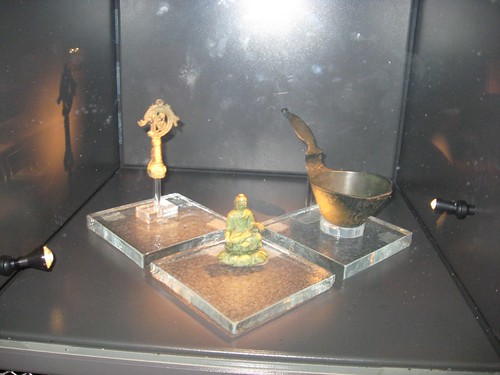
The mounds in the Kyoto area from which the beads were found were huge (see an imperial example above). The sheer size shows that they belonged to the highest section of the society and suggest that the exotic finds did have extra value that made them fit for important funeral assemblages. As an Huffington Post article points out, there is one Indian Buddha from the Helgö island (in Sweden outside Stockholm) that was an important Scandinavian trading post in the sixth century AD. These finds show that the period saw at least single objects travelling vast distances along the exchange networks, perhaps changing hands regularly in gift giving or exchanging knick knack. Nevertheless, these can be classified as exotica reaching their ultimate, distant final destinations.


The Helgö Buddha and other objects

Thursday, 21 June 2012

Day of Archaeology 2012

Friday, the 29th of June will be the Day of Archaeology. I have now volunteered to a web project that records what different archaeologist all around the world will be doing on that particular day. The results that will be uploaded onto the web on that day or during the following week will give a snapshot of the landscape of archaeological work in progress. I was first a bit unsure since what I do at the moment is far from exciting – unless you find a picture of a computer screen turning you on. I will be likely to be working on an article, digitizing pottery drawings or, if I will be extremely daring, having a trip to the University Library or Classics library to check some references or knocking up a couple of GIS illustrations at the Department. However, the organizers saw this scenario ‘exciting’ since it involves something else than fieldwork, although I am not sure if they are expecting literarily to get a photo of a laptop with Word or AutoCad open on my home office table. This will be a quite likely outcome...

I was told about this web project by the local archaeological officer who together with the local Portable Antiquities Scheme officer took part last year. Their contributions will be representing work that is going on within our council. Since the Day of Archaeology this year does not coincide with the British Festival of Archaeology between the 14th and 29th of July, their work will be less connected with the series of the Leicestershire events during that week. It will be interesting to see if their posts this year are to involve a lot of interaction with public and photos or videos to show them involved in archaeological dissemination. Their last year’s contributions concentrated on the Hallaton Treasure and finds work. Finds Liaison Officer had cunningly ‘outsourced’ her contribution.

Last year there were contributions from places as far apart as Iceland and Tokelau in the Pacific Ocean. There was tattooing in Hawaii, conservation in Ecuador and guiding in Zimbabwe so the breath of topics was the widest possible (see the map of posts). One has to admit that the contributions concentrated to the Anglo-Saxon world. The showcase selection on the map of posts provided contained only one posting from Africa and Asia respectively. Central and Southern America were represented by three posts. However, all the contributors will be presented in a photo wall. Even our Institute for Archaeologists had an entry. Due to the timing, many of the 2011 contributions involved fieldwork, although there were surprisingly many university teachers, museum professionals and students presenting their institution and work there. Thus, the photo wall allows a scene for positive ‘advertisement’.

If you are interested to join the Day of Archaeology 2012, you can go and check the project web page or join up by e-mailing dayofarchaeology@gmail.com. There seemed to be anything from the descriptions of desk-based postgraduate study to voluntary work and videos so everything seems to be counting. I even found a photo of a laptop with Word open from last year – not to mention the illustrations of computers with digital archaeology work. However, I may be considering timing my visits to see a couple of collections for potential teaching or similar in a convenient way to show something more interesting than my normal duties. It is a pity that my visit to Rome will take place at the very beginning of July...


BAJR lap top

Thursday, 14 June 2012

The unbearable lightness of archaeology

No matter how interesting archaeology is and how intellectually rewarding it can be, sometimes real world seems to catch with it and deem it less worthy when weighted against the events in the real world. Lately, a few discussions I have had over a cup of tea have involved meditations on the situation in Syria and a selection of pretty pessimistic predictions of the possible outcomes. Even if I only ended up working there for one season, I could see how exceptional history the country has and how versatile its communities could be. Now I can watch the TV news only with a deep feeling of sorrow.

When I have discussed with people who have been working in the Middle East for decades and have long working relationships with local archaeologists, museum professionals and workmen, I can only guess how they feel at the moment. If seeing sectarian violence raising its head and another country being ‘iraqified’ is heartbreaking for me, I can only guess how those experienced archaeologists must be feeling. The government in Syria did not bring freedom of speech to the masses or freely elected leaders but it had created a country where the Sunni, the Christians, the Shia, the Jewish and the Alawites were living peacefully in a lay country. No matter how the situation will pan out now, the relationships between different communities will not be trusting or carefree any more. Some groups already have blood in their hands.

The unstable political situations bring stop to foreign expeditions in different volatile countries. Anybody who was as blue-eyed as to have wished that the Bush family’s long-term project in Iraq would open the country’s fabulous archaeology to the scholars could have not been more wrong. The collections were trashed, the sites flamethrewn and different buildings bombed or blown out. Nothing makes an easier target in a dangerous country than a locally well-known and instantly recognizable foreign archaeological team. I have heard of a few teams in different countries who have lied low for some time when drug traffickers or other dangerous groups had visited an area.

In a country such as Syria were a huge amount of sites – including Ugarit, Palmyra, Tell Braq or Crac des Chevaliers among many others – has value for world history any conflict can have far reaching consequences for archaeology and museum collections. Naturally, the discontinuation of research projects is a blow to the individual careers of highly competitive archaeologists. However, ethically, these losses have to be considered, even if enormous in the case of world heritage, to be of lesser importance than a potential loss of human life and the potential tragedy of losing one more country to the dark depths of civil war and carnage. Europe itself has been unable to avoid bloody ethnic wars and atrocities in the 1990s so how could the area as volatile as the Near East.


From the beach

We did work next to a beach site with party boats, countless chalets, a long row of souvenir shops and people happily having their day by the sea. The site was used by local tourists but it may be eerily quiet today. One could see Turkey from the beach, and a number of Christian villages are located in the area. The area is relatively near of some of the northern trouble spots but should be peaceful at the moment. If only the worst could be avoided and not only the archaeology but all the citizens and communities could be safeguarded.