Friday, 26 July 2013

Done and dusted

Creating an online course that combines critical thinking with teaching new computing skills was always going to be a hard call, but I think I managed to give most people valuable assets. Now when it is all over, I can assess how the course went and if it was a success or not. Naturally, I have to take into account that this course was not accredited, so no student had to do all the parts; nothing was totally obligatory, but in order to get a certificate, one had to be active.

All but one got the certificate. The only one who did not, only logged in once. May be I will hear in the future, if the contents were unexpected (it is totally conceivable that some people may consider the course to be more about the sites and they could just consume maps and imagery other people had prepared instead of participating in exercises), may be something happened. At least in England the weather became unusually splendid and truly hot, so the student may have decided to vanish to the seaside instead of ‘slaving’ week after week in front of a computer and putting some hours into learning.

It is clear that all ‘certified’ students at least checked the material every week. Some made comments to the discussion forums and two thirds sent me back their mini projects for comments. All those received were good in different ways. The project work made it clear that probably those who had some kind of degree in archaeology got the most out of the course. However, even the self-confessed technophobe did get important cues how and where to look for information. The best of the project work added to personal projects students are actively carrying out in their own regions. In fact, one of the projects presented original work. It will be of wider interest for British archaeology and I wonder, if we will find the results in an article in the future...

Thursday, 18 July 2013

Vampires in archaeology

While reading student assignments, I was amused by a newspaper story reflecting the July mid-summer news draught. Archaeologists in Poland have made an announcement that they have found vampire burials. The interpretation why these particular burials would be those of vampires rests on the fact that the skeletons have their skulls between their thighs. A fact undermining this sensational interpretation is that there were actually gallows near the excavation site in the past, as reported by a local paper and the Guardian, so at least I can come up with a likelier option. They probably were bad people, but vampires – I do not believe so.

However, it seems that the vampire burials are relatively common in eastern Europe where the folk tradition includes undead sucking blood from the living. However, the examples from Bulgaria have had iron rods stuck in their chest, which kind of conforms with the way to kill a vampire. One can only imagine what kind of mass hysteria can break out when for example a mentally ill individual with gum disease or tuberculosis attacks somebody trying to bite them. This kind of situation is perfectly plausible, so with strong superstitious beliefs a community may resort to nasty ways of getting rid of a troublesome individual.

Nevertheless, the undead are now fashionable and different tv series presenting vampires or zombies or both, as Becoming human on BB3 did, are fourteen a dozen. Humans are fascinated by an idea of eternal life and the complexities related in The returned, partly acting as allegories for racism and xenophobia amongst us as In the flesh did. Many archaeologists are looking for their Tutankhamen’s grave – or at least a possibility of gaining media attention and funding for their project.

On a serious note, there seems to be a vampire landscape forming. If these individuals deceased in unusual ways were thought to be vampires in the past, remains unclear. At least the different stories from around Europe, including Italy, reveal the extent and geography of modern contemporary archaeological vampire narratives.

Thursday, 11 July 2013

20 years of taskscapes

This year I and Philip Mills will organise a session 20 years of taskscapes: from temporalities to ceramiscenes in the Theoretical Archaeology Group conference in Bournemouth. If you have missed the advertisement for this year’s TAG, you may not be alone, since you may remember from my earlier blog post how we were tracking down this year’s site at the beginning of the year.

This year TAG will be a TAG-on-Sea. Naturally, since it will be in Bournemouth. However, I assume there will be no beach weather on December 16–18, 2003. Considering the previous years’ weather around that time of the year, we may even see some snow. This did not do too much harm to the Durham or Bristol TAGs I remember from previous years. The TAG 2013 web site is now up and running with all the information on registration and submission you will need.

If you are interested in taskscapes, we are happy to consider any papers sent to the conference organisers for consideration for this particular session. Our session is advertised on their Submit a session/paper page. The session addresses two different themes. Firstly, the importance of taskscapes in archaeology and their application to the study of cultural landscapes; Secondly, the developments of the taskscape concept in the last twenty years. We are interested in papers that will evaluate the concept of taskscape as related to heritage, landscape and material studies from any region and for any period. If these themes are of interest and you will be available on the given dates, send the organisers a title and abstract and we will come back to you and your theoretical and methodological ideas.

Thursday, 4 July 2013

RIP Mick Aston

After moving house and finally getting the broadband reconnected, I managed to update my blog. During my enforced break from blogging among the sea of cardboard boxes some archaeological news have reached us. On one hand the University of Leicester is to continue the study of the Greyfriars in order to study some other graves under the car park and on the other a Durham student has found a head of a statue from a Roman shrine. However, the biggest news during the last two weeks has been the demise of Mick Aston.


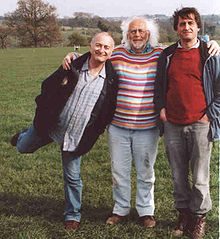
Mick Aston (centre) with his Time Team colleagues

I did meet Mick Aston personally several times at Bristol when I was studying for my MA in Landscape Archaeology. When I arrived to England, I was totally ignorant of Time Team, since it had not travelled to the Continent, yet. I was wondering the knowledge of geophysics my fellow English students seemed to have. I only understood after viewing the programme.

Since I did not take part into Time Team, I only met Mick in some departmental functions and trips that were part of my taught course. We visited the Shapwick village, the site of the project Mick ran for decades, where he personally explained the history of the project and the resulting depth of knowledge of that village.

He was a gentle man, liked by the PhD students who helped him in his media research. His wild hair and colourful jumpers seemed to be part of his role, but also implicated his jovial and relaxed nature, which was not some added 'pepper'. We all witnessed how Time Time slowly withered away. It was a pity his last year was filled with some controversy and ill health. However, his legacy in British landscape archaeology will live on.


If you have not read Mick Aston's famous text books, Landscape Archaeology: An Introduction to Fieldwork Techniques on Post-Roman Landscapes (with Trevor Rowley) from 1974 and Interpreting the Landscape: Landscape Archaeology in Local Studies from 1985, you can introduce yourself to his speciality by reading this short treatise on the Medieval landscape in Somerset.

Thursday, 13 June 2013

Early experiences from running an online course

The greatest surprise this far when running my Googling the Earth online course is the amount of 'proofreading' it requires. In the end it is not enough that you come up with an idea, sell it, prepare the material and hand it over. One also has to make sure that it is correct, since the lovely people in the e-learning department do not know the subject matter. In the end, the person who has created the material knows the order it has to be presented for a maximum learning effect and how different parts (podcast, audio PowerPoint, web pages, exercises and links) link and build up into a learning experience.

I have realised that I have probably included too much content into the course. This is quite normal for an academic archaeologist; you just think the amount of basics people have to grasp in order to be able to process certain new topics. However, the learners probably do not have too many hours per week for studying, so I hope I have not prepared too much to be ploughed through. On the other hand, one had to prepare for a situation where you have a novice in landscape archaeology who wants to use different online resources and give them enough of the context in order to be able to carry out and understand the exercises.

Designing the exercises was also a little daunting, since some of the course participants are really active in their part-time study or have membership of different fieldworker or archaeology groups. If they are really computersavvy, they can do exercises really quickly. There may also be some topics they consider knowing enough and they skim the content and choose the exercises they have been looking for. This makes it a difficult balancing act.

The most unpleasant thing is checking the sound tracks. I am not used to listen to my own voice and I am sure one picks oneself all those awkward pauses, hesitations and scrambled words to the maximum effect. Luckily, there are the bullet points to read for the students and in places it sounds OK. It is a pity I did not have the instruction book for the audio recorder, so I did not try forwarding or rewinding the tape. Next time I will do more retakes!

Even if we do have a discussion forum, I do not have direct contact with the students when they are doing the exercises. Thus, any sticky points will come out only later – and only if they comment on them. In this type of course they do most of the work themselves. Luckily, they will send me a very short mini project of their work at the end, so I will know if they found it useful and learnt new skills. If so, I will be content.

Thursday, 6 June 2013

Secrets of the Stonehenge skeletons

I finally had an opportunity to see the Stonehenge documentary, repeated on More4 in a comfortable 9 o’clock slot recently. Even if at the core of the programme there were some interesting hypotheses, some better established than the others, some of the attention ended up directed to a series of design choices that clearly were made by the production company and outside the powers of the archaeologists.

We all have probably recently been complaining about the irritating re-enactments in archaeological documentaries. There are the pretend ancient Egyptians in their thick black wigs carrying bowls in dark corners or sitting on replica chairs when intriguing modern classical music is playing. There are the screaming attacking armies of the barbarians, Persians and/or Celts. There are the Iron Age People cooking in their woollen clothes in a dark round house, when the smoke is quietly floating around, while a voiceover keeps repeating the same mysterious lines over and over again. However, this time the budget may have been smaller than normally, since any alive re-enactors were replaced – by shadow puppets. The kind of puppets you see in the south-eastern Asian displays. This was a true novelty.

The documentary also kept repeating the same shot of Mike Parker Pearson walking among the stones of Stonehenge and observantly look up to their top parts. This section reminded me in an unintended manner of the movie Plan 9 from Outer Space. In that movie, voted to have been one of the worst ever made, a section with Bela Lugosi, then already deceased, and some other shots were reused continuously. However, this documentary I was watching naturally was light years better than the movie, but the continuous repetition of the same scenes hints that the programme uses the building up of intrigue techniques that repeat same questions, such as ‘why did the use of Stonehenge stop so abruptly’, before the ad breaks. The continuous repetition also suggest that there was really material for a 45-minute documentary, but the programme had to cover a certain slot. Although there is always more than 45 minutes worth of stories from Stonehenge!

On the positive side, it was crucial to get a neat summary of the findings of the excavations of the Aubrey Holes in this programme. However, some of the arguments were surprising - although the script must have been edited by the production company. The programme makers suggested that before the Riverside project people did not know that the first Stonehenge did not have the stone circle with headstones in the middle. However, Atkinson had already written in his book in the 1950s that the first Stonehenge was a simple henge with a ditch. The important Riverside novelty was the observation that there were probably bluestones instead of wooden poles in the Aubrey Holes. This is a true novelty, but not the same thing as them finding out about the simple first henge for the very first time.

I really appreciated the study of the reburied cremated bones from the Aubrey Holes. That must have felt like a very daunting task at first, but the cleaver use of ear bones as the marker of the number of individuals was impressive. Nevertheless, I am not sure how the presence of burials of both men and women together with children was evidence for the existence of a special religious order at Stonehenge and the members of which were buried there under the first simple stone henge.

Another thing that made the re-excavation of the Aubrey Holes bones remarkable was that every single director of the sub-projects of the Riverside project took turns in carrying out the humble duties of excavating with trowel.

Thursday, 30 May 2013

Central Mediterranean Prehistory Day: from Sardinia to the Balkans

Just when I had started to wonder, if I remembered correctly and if there was a Central Mediterranean day in May, I received an e-mail containing the programme of the research day at Cambridge. I had originally other business on that day, but it was cancelled I could have now given a paper. However, the programme was full, so I could relax and listen what other people had prepared for the day. It was a very interesting day, presenting a few of the new ERC funded projects and a lot of Sardinia.

Even if I am not going to lose my interest in English landscape, the things have taken an unexpected turn in such a way that I will mainly concentrate on central Italy the next academic year. This is not bad, since I have still a lot to prepare for publication and this spring trying to improve my teaching portfolio has taken most of my time – when I have not been finishing money applications or articles to be sent for peer review or to be submitted. At least those hours spent in writing hypothetical research proposals have not gone totally in waste. For 12 months from September I will concentrate on Archaic and colonial geographies. Not that I won’t be following a side project as well on my spare time in order to improve my chances in multidisciplinary discussions...


EUROFARM project web site

The Central Mediterranean Prehistory Day was during the same week as the social media and public archaeology workshop that I wrote about last week. This Mediterranean research day was not without its fair share of computing. EUROFARM project headed by Marc Vander Linden is going to model the early streams of neolithisation along the Mediterranean coast and inland in the Balkans, where these different innovative strands are the nearest in Europe. Craig Alexander, when not working with rock art, will be doing GIS for the archaeometric XRF project in the Neolithic Tavoliere, whereas Francesca Fulminante was presenting her network analyses. PROCON project, directed by Margarita Gleba, will not model as much as many other projects, but study textile economy and urbanisation extensively using different kinds of analyses, targeting especially visual media from 1000–500 BC. They try to find new methods to deconstruct iconography along the process.

Unusually large part of the day was devoted to Sardinia, which was delighting, since the archaeology of this island is not as familiar to me as it should be. We heard Guillaume Robin’s presentation about studying Neolithic art in the rock cut tombs whereas Florian Soula was mapping the meanings of the Sardinian standing stone phenomenon. Luca Lai tried to look at the short and long cycles of different cultural chronological groups and how the subsistence basis and cultural manifestations fluctuated accordingly. Fascinating. Especially when some authors tried to get away from the pre-Nuragic/Nuragic separation, whereas the others used it in a more traditional manner, for example when tracking the trade in the eastern Mediterranean.

I also learnt what the Rome researcher at the British School at Rome will be studying: marginality. It will be interesting to find out if Elisa Perego manages to explain why northern Italian late prehistory seems to have much more marginalisation in its funerary customs than the central Italian ones. However, we may not have observed the material with her eyes, yet.