Sunday, 20 March 2016

RACed and TRACed? Part 1


Reconstruction of Portus as presented by S. Keay during the key note talk

The Portus trip at the very end of the Roman Archaeology Conference in Rome went more or less pear-shaped from my part, but otherwise I enjoyed Rome in March as one could be expected to. I was suggested in beforehand that a conference this big may be irritating and tiresome, but even if I missed some talks due to people dropping out and the schedules being tinkered at the spot, the general feeling was as sunny as the weather outside on most days. The real problem, and really down to myself, was being at Sapienza University at time early in the morning. This in turn turned me into an old lady by Friday evening, so instead of any Mostra opening or TRAC party, I and my colleague Eeva-Maria Viitanen who had her talk last in the conference on Saturday as one of the handful delegates, we headed for a quiet dinner near Doria Pamphilia.
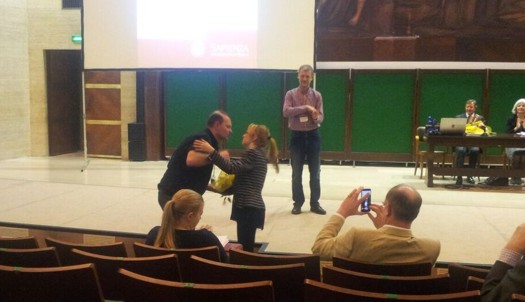

Well deserved thanks to Chiara Maria Marchetti

Generally, the conference was well-organised and the things that went slightly awry were nothing in comparison with one truly chaotic conference I have attended in the past. All the rooms had functioning laptops and projectors, there were plenty of nice students to help us and the conference secretary Chiara Maria Marchetti was an ever-present fixture everywhere. Things got sorted promptly without delay. The poster session advice however changed along the way and there could have been signs on the walls to guide the delegates to the right lecture rooms, not only in the conference booklet. At the beginning I was a bit out of my breath – mainly because I came to Rome after a quick detour to Florence – but the coffee breaks and lunches were served also in the Museum of Classical Archaeology among the casts of the statues, which gave grandeur to the proceedings. It took a couple of hours to get going and by picking up interesting lectures and themes from both the RAC and TRAC I created a versatile programme.


The book stalls among the cast collection

There were even special effects. In the Sensing Rome session the air conditioning in the Odeon was working on overtime and my choice of short-sleeved dress for my presentation day meant that I was quite cold before it was all over. There would have been a possibility to Hoff one session for being an all-male panel, but considering who were present, I decided that it was more important to bring in a female voice by making a relevant question and take part in discussion in Italian; I did get a very good answer. In general, there were plenty of female organisers – as in the Urban Streets session where Eeva-Maria was speaking – and there was a whole session for Sex, Gender and Family (see the session list).


The end is nigh at RAC/TRAC2016

Most importantly, in the opening address the Superintendency in Rome was thanked for our free access to some sites and we were reminded of the challenging times for heritage management in Italy. We were also reminded of the struggle many of our colleagues are having and there was a wish that the loss of colleagues that stood for their heritage was not for vain. This was nice to hear, especially since my colleague was just telling in social media the story of a female colleague that had to leave everything behind and flee for her safety.

The delightfully cheap conference dinner was an enjoyable treat, spent discussing with Peter Attema from Groningen and Simon Malmberg from Bergen. It turned out that the latter was very familiar with my research, as he himself suggested. He had been in the panel that had evaluated the candidates for a Mediterranean lectureship at Oslo and he was suggesting that my research was impressive. He also shared a taxi back to Gianicolo after a nice evening.

My Friday was busy, since I was live tweeting all afternoon, not only presenting in the morning – and we were literally running a chair-it-yourself session. The first speaker was a real star and started promptly on time and finished in a similar manner while giving a good talk on Urban Structure in the Graeco-Roman world. He even loaned me his watch, so I could time my talk. With his help and little assistance from the nice students, I managed to finish on the spot and hand the turn to the Vindolanda talk. As my friend suggested, we could have been pouring our content to the listeners without any regard, but we were very civilised.

I will come back to some of the highlights I heard in the Part 2 of my conference posts. I will also come back to the Archaeological Museum in Florence when I have a slot in my weekly blog.


Rome in March

You know, it was fun. The enjoyment was increased by being able to eat breakfast on the sunny mornings on the terrace looking at Rome at our feet. I am lodging next door to emerita Margareta Steinby who has every now and then commented delightfully the everyday happenings we have faced. Now I just hope for uneventful travel.

Sunday, 13 March 2016

Waiting for... but reporting

Some week's are in a funny way without major reports for public domain. No matter how much one travels or works or does. This week is one of those while waiting for next week that will undoubtedly provide blog feed for a couple of weeks. I did work a couple of weeks home, do my presentation for next week, attend meetings in London and tweet from a lecture, travel to Stockholm and sort out some software issues there and visit a major shopping area outside Stockholm for some essentials. However, the matters discussed in the meeting are confidential, the tweets are out there to be looked for and the research will be reported in its due course. Last weekend's CAA-UK was already reported in last week's post. In a way it is all about waiting. Everything begins to be ready for the Roman Archaeology Conference and Theoretical Roman Archaeology Conference next week.

In addition, I missed one of this week's major events at Stockholm, the latest from the Iron Age team working for The Atlas Project (or let's give its full name The Atlas of Ancient Human Genomes in Sweden) that tries to look for the population movements during the Swedish prehistory and for any hints of the stability or changes in populations during the key moments of transition. Naturally considering only periods when the burial rite was inhumation and we have skeletal remains. Luckily, the key team is located in the office opposite me, so I heard all about it the following day when I returned. It is all so red hot new from the presses that I leave any reporting to them via proper channels. I can only say that the things I heard will give new information on late Iron Age society.

It is a pity I missed the talk, but at least I had nice chats with my colleagues the following day. While they were discussing the Iron Age, I was reporting from a similarly interesting find, the Whitehorse Hill Cist in Dartmoor. This find in the blanket peat has revealed astonishing finds that have been presented lately in many lectures around Britain, as they were also in the Royal Archaeological Institute lecture on Wednesday. The cremation was excavated in a laboratory and it has revealed some unique features, including unusual preservation of organic matter, and many that are rare, but discovered in other parts of Britain as well. Some features just reflected what was common in the Dartmoor area in the Early Bronze Age. Of the unique features, the most unique were the pure tin rivets of an arm band and a bear's pelt. There was also a copper alloy pin and amber and shale beads in a colour-schemed neclace. The speaker, Dr Andy M. Jones, remindered us that a single flint flake, a common feature in the region, may have been the only object to be found in a burial without pottery had there not been the peat.


The bead necklace (linked from the Dartmoor National Park web site

Sunday, 6 March 2016

Will I CAAuk it?


CAA-UK: one of Eve's title pages

This has been one of those weeks which have been extremely busy. Even so I managed to ram in talks and conferences. I am starting to scribe this on a flight back to Britain, with the ambitious plan to head to a conference on Saturday in Leicester – even if I won’t be back home until midnight. I have not registered to the conference either, but it is in Leicester and the CAA-UK, which is definitely not a stuffy conference at all. I have been slightly unsure of the timings with Phil’s best friend around, but now it seems that I will be able to attend the wine reception. I will see how things develop otherwise. I have not booked the conference dinner, but if it is anything like the previous conferences, the things should work out. Or I will head to bed. I will be country hopping the coming three weeks anyway.

This week saw one visiting scholar and one final seminar with an external opponent by a PhD student at Stockholm. The visiting scholar was Professor Clive Bonsall from Edinbufgh who was presenting the evidence for the change to the agriculture and proper Neolithic along the Danube around the Iron Gorge. It was a fascinating tale of old excavations, badly published in the Balkans and isotope studies going back to the 1990s. It was interesting to know how different scholars in different universities are piecing the evidence from different samples – all somehow stabbing in the start without proper final publications of the excavations. Even Lepenski Vir came out of something stitched together from different overall descriptions and preliminary reports. Suddenly my own sins in non-published fieldwork – only eight years aback – feel like small potatoes. I promise to work on it in the summer – if the current research allows.

The final seminar was all about southern Swedish bronze moulds and their social context. This seminar was fascinating due to the fact that the opponent had been an excavation director and report writer at many of the motorway excavation sites this PhD and its case study along the Mälare area was based on. He was very polite – but could make so many suggestions how to improve the manuscript. He even attended the meal afterwards in my favourite beer restaurant in Stockholm – the Kvarnen. He also made me wonder if they were talking about the sites around Uppsala I visited all those years ago as a fresh student on a student society trip to Uppsala. We headed to some very muddy motorway excavations in Uppland – but I think they were Iron Age.

The most interesting part of this PhD is the fact that the doctorand is able to make a difference along the gender lines in the social context of bronze crafts. If the mould fragments were found in the long houses, they seem to testify of the manufacture of dominantly female objects, but if the mould remains were found in ritual houses, they tend to have been used to mould male objects. Certain objects were manufactured in both settings – among them the daggers and the swords. Absolutely fabulous – although I was surprised the PhD candidate had not used weights of fragments from different sites to measure the magnitude of bronze craft industries. In any case, the manufacture seems to have been dispersed and not particularly managed by any elites. I hardly can wait for the public viva. However, we have to wait until 2017 according to Anna who now has a lot to ponder from the constructive and measured comments.


CAA-UK: Joyce discussing using drones

So fastforward to the Saturday morning and the CAA registration – that turned out to be online only. However, these things sort themselves out. As did my attempts to semi-live or live tweeting. This conference was going to be my test run for a live tweeting session I will have in Rome in the Roman Archaeology Conference. I thought it would be good to see, if my old smart phone still could make it (no, it does not) and how it all will go in an unfamiliar environment. Switching phones became an operation. The conference – in an auditorium underground – reminded of other important aspects. The wifi was on and off and there was no mobile phone reception, so there were limited back up options when wifi was off. This one test run was done without much preparations, so for the real run, one have to make a list of the essentials. Luckily, the live tweeting will be on the third conference day, so I will have time to get the basics right. I will have time to check the room beforehand, see the general wifi performance during the conference days and do some test tweeting on my own behalf before performing.

The conference day in itself was fantastic. It covered some lines of research I have to return again – and it seems people are making astonishing progress. However, the day began with Libya, as it is fitting at Leicester with the Libya archives and large projects across northern Africa. Louise Rayne presented the Endangered Archaeology image interpretation methodology using Google Earth in collaboration with Oxford to map damage and destruction for all kinds of monuments in the Middle East and North Africa. Hopefully, training of Libyan archaeologists will guarantee that the EAMENA database will continue to be updated after the end of the project. After Libya we headed to Madinat al-Zahra in southern Spain. This early Islamic town site has been studied with geophysical methods. Now they have experimented with the use of portable XRF in order to see if the anomalies in the magnetometer survey coincide with the hotspots with certain heavy metals. This pXRFing the top soil works probably at the metal working sites, but the discussion between another team suggests it is problematic.


Casswell: comparing the cost surfaces from different terrain types in Britain

Then Daniel Joyce presented different possibilities in the development for drone use in archaeology, restricted by very limited fly times defined by battery charges, for which there are lines of solutions coming up. However, the possibilities range from site surveys including multispectral recording to site tours and building recording. After this more general overview there were a series of good papers on Britain. A number of papers, including the single and joint presentations from Michelle De Grouney and Edward Casswell from Durham, explored the current work on cost paths and cost surfaces. It became clear that the finer detail of the models is becoming more reliable with new research on differences different walkers have on different walking surfaces and better understanding how different algorithms in different software packages affect the routes of cost paths and size of cost surfaces. The discussions were even more interesting than the papers, revealing the new localised work in order to understand land cover in the past.


Sycamore: hoard sites and locational precision

The papers discussing Roman Britain hoards by Rachel Sycamore and one aspect, in this case field systems, studied by the English Landscape project by Chris Green delivered food for thought on these very English site categories. The reliability of the historic hoard find was an issue for Sycamore and she has not quite decided if she will go for fuzzy classification or weighting better known sites. At least the poor data does not cluster. Green on the other hand has managed to find chronological differences between coaxial field system sites and aggregate sites. He was searching for suitable metrics for analysis on the character of field systems. He could find a difference between the elevations of the Bronze Age and Iron Age field systems as compared against the national values. In discussions he suggested that more ways to compare the systems may come in their landscape context.

So did I CAAuk it? Well, at least I hope to be back next year. Sadly, I had to pass today's second day due to Mothers' day and other commitments. The day I could attend finished well with Stuart Eve's paper on augmented reality. The previous attempts on non-digital augmented reality with door frames in Bodmin Moor was mentioned, after Stuart presented his more restricted views from virtual houses. However, it was his aural and smelly experiences, using mobile positioning technology - and infused cotton wool in the case of smells - was truly augmenting heritage reality. The wearable gear in the smelly tour did not look very appealing, yet. So that was the day it was. Next, I will country hop from UK to Sweden and then start to ponder (T)RACing it.

Saturday, 27 February 2016

The firsts - at Lund and Stockholm

This week I have spent some quality time at the airports – not always in happy circumstances. The week started with some moments dedicated to cursing the wifi service at the Gatwick airport. Norwegian did not manage to get the cabin crew together at one end or another so my flight to Stockholm was 2.5 hours late. The Gatwick wifi – all 45 free minutes of it – is provided by a private company and the web site does not always work or it is very slow to get you into the contact with the service. Naturally, all recharging points except for five around one column were out of order. This meant that inevitably the battery was heading to flat and most of the 45 minutes was spent waiting for the web pages to load. Luckily, I had decided not to come with the earlier train...


The seminar audience

Back in Stockholm I managed to make it to the shop with half an hour to spare, but otherwise it was straight to bed and straight to the University in the morning. I was back at Arlanda the next day in order to fly to Lund that I visited for the first time in my life. I was giving a talk about my project, funded by the Swedish Research Council, for which I had returned to work at Stockholm, and meeting some colleagues. The visit was a most pleasant one.


The LUX building

The Section of Classical Archaeology and Ancient History is placed together with other archaeological disciplines and other Humanities and Theology in the new Lux building in the university area. Lund is one of those old university towns where everybody is cycling among the Medieval buildings. It is very similar to atmosphere to Uppsala or Cambridge in that manner. Even the bus trip from the Malmö Airport gave you experiences. Skåne where Lund is located – together with the famous detective Wallander – has always been influenced by Denmark and it was even at one time part of it. There are no red farm houses like in the Stockholm area or in Finland, but white plastered wood-framed historic buildings in a relatively flat landscape.


The Medieval Cathedral peaking

The talk went fine and I had a series of comments and questions. How quickly one and half hours do fly. Afterwards we sat round a cup of coffee before heading to the Bishop’s Arms for a postseminarium. It was a splendid choice to take a later flight back to Stockholm, so we had time to talk about Blera and other topics. Then it was time to face the curse of airports again.


In the countryside

I had hoped to get quickly to the city centre using Arlanda Express, but when I got to the station the train was just standing there on the way to nowhere. There had been an accident somewhere north of Stockholm and the service may have restarted in an hour, but I and other customers headed for the coach services instead. Mine was slightly raising my heartbeat, since I live in a new neighbourhood to me and was heading to a local train station I had never been before. I only knew that my train stops there. But all well that ends well. Back to work the next morning as normal. With the cold symptoms Phil had the week before.


The Swedish viva setting

My Friday afternoon was saved by my first Swedish public PhD viva. This viva was not about any Bronze or Iron Age sites in Sweden thesis, but a tightly packaged 332 pages on Funding Matters: Archaeology and the Political Economy of the Past in the EU by Elisabeth Niklasson, who had attended The [late] Research School of Studies in Cultural History at Stockholm with two other PhD students in archaeology. Her opponent was Björn Magnusson Staaf from Lund University, although working there as an associate professor in charge of museology. It was interesting how different this event was from my ‘three people in everyday clothes in professor’s office’ Cambridge viva and from the full pomp and formality of a Finnish viva with men in tails and women defending in black dress or suit in full academic regalia with the kustos (as in 'custodian') nodding between the defending PhD student and the opponent, usually being a professor or some other unfortunate soul taking this ceremonial relic role from the 17th century. No sword fights nowadays.


The opponent explains

A Swedish viva – at least this time – is a very polite and good-natured event in a darkish dress or a jacket and trousers combo. What was surprising to me was that apart from the defender commenting potential typos in the thesis, any summarising was left to the opponent. In an English viva the defender is normally asked to tell what it was all about and the Finnish viva starts with a defender's summary and comments. At Stockholm there were some questions addressed to the defender, but nothing too dramatic and everything was more like one of those discussion programmes in TV where an expert is mildly questioned about some issue of today.

The thesis showed amazing amount of work. Not only interviewing about 30 stakeholders in detail, recorded and all, but also analysing a huge amount of policy texts and call details and looking at the process of financing archaeology within an European framework. The thesis lists the archaeological projects that have got funding from the main EU heritage programmes up to 2013. At the core the projects can be seen exploring and creating Europeanness. This is more than clear when you read through all the project names and their abbreviations. However, it seems there has not been a unified policy to use archaeology in the present identity creation by the EU - at least after 2007 when archaeology was not specifically mentioned in relation to European identity or research policy.

Before heading back to my lodgings, trying to shed the aches and pains by sleeping, I attended the reception while we waited the grading board to return and tell if the thesis had passed or not (not a difficult guess which way it went). A little of bubbly and an interesting discussion with our new Hungarian osteology professor wrapped up an interesting afternoon.

Saturday, 20 February 2016

Tut’s it?

Once upon a time there was a tweenie who found ancient Egypt very exciting, even romantic. She had been reading memoires of early explorers, especially those women in the 1920s and 1930s joined the trips to Africa or did animal observation somewhere. She also ended up loaning Christiane Desroches-Noblecourt ’s book on Tutankhamen and was mesmerised by the fragmented evidence for the family history and all the faded characters in the saga, including all the minor pharaohs and Tiye and other women. The Amarna age and monotheism was a safe haven in the still slightly religious young eyes and there was all the splendour and adventure to count in.

Fast-forward – ohm – quite a lot of time and the same girl was sitting in front of the television on a Friday night while her husband was in a Green party meeting and wondering if anything good will come out from Channel 5. Or if she should even be watching anything from a channel the recent archaeological offerings have been less than ethical. However, the theory of the secret chamber in Tutankhamun’s tomb had got a lot of publicity and number of articles in journals and some in the archaeological and heritage community had got excited. However, the young mesmerised tweenie is now a somewhat more sarcastic character and the monotheist hero of the past in ancient Egypt looks like quite a deranged zealot with many health problems who moved a lot of people onto a very dry plot along the Nile. No wonder all ran off as soon as the pharaoh was gone.

It all promised a good story, though, and I wanted to know more about that potential chamber where Nefertiti was supposed to lie. The programme started promisingly with a specialist telling how different items in the tomb where made potentially for a woman (there is apparently a wide academic back catalogue on this) and how the famous mask was a composite and the ears had belong to a woman (ditto). However, the bearded male theorist was joined by another male specialist, this time with glasses and significantly less facial or other hair, from one of my former almae matres, the University of Bristol, which made it all far more interesting, starting to trace another story for the current whereabouts of Nefertiti.

Talking of Nefertiti. Quite a lot of air time was actually given to the bit part players who were re-enacting the young Tut and the royal couple, Akhenaten and Nefertiti. I hope they had afforded slightly more expensive head gear, considering the flimsy number the young Tut was wearing. In addition, calling Tutankhamun constantly ‘Tut’ gave the programme not a popular flavour they probably were after, but slightly down-market one (not helped by the head gear). Not only feeling a bit ‘tut tut’, but ‘Tut’ also easily rimes with ‘tat’. Not necessarily the association the programme makers wanted to have.

The theories were actually quite interesting. The bearded specialist, Chris Naunton, Director of the Egypt Exploration Society, was explaining the way Tutankhamun’s burial chamber may actually had started as a corridor to another, original burial chamber. The sealed and concealed rooms were a feature in pharaonic tomb chambers. There even were suitable unevenness in the ceiling to conform to this theory. The art historians had made a nano-level accurate model of the tomb paintings that as a 3D laser scan and its 3D print also faithfully reproduced the surface of the wall. There are all kinds of lines there and a red rectangular was place on one part of the painted wall. All quite plausible, but this specialist just was not Nicholas Reeves who originally made the claim. He did pass the space in front of the camera during the programme, but he was not a main character, just passing. What was going on there?

However, the University of Bristol expert, Dr Aidan Dodson, painted a totally different story. Nefertiti has actually potentially been found, one of the female royal mummies reburied after the ongoing tomb robbery in the Egyptian times. Dr Dodson was standing next to a display case, where a visibly beautiful woman, showing some resemblance to the famous bust, but unfortunately having a very nasty rip where the mouth once had been, was lying. This woman, he asserted us, was the biological mother of Tutankhamun, as evidenced by DNA testing of female mummies of the Amarna age. The father definitely was Akhenaten, but the mother has been assumed to be somebody else but the main wife, Nefertiti. The DNA suggested that the parents were brother and sister, but Akhenaten did not have any known sisters. Possibly the continuous marriages between first cousins and siblings resulted with the similar DNA? This woman thus could be a Nefertiti, actually.

What became clear was that Nefertiti is very much still dead and her mummy can be here or there. But what about that secret chamber? Then came the major disappointment: after having shown quite a many shots of the scanning and printing of the wall, the recent thermal imaging of Tutankhamen’s chamber was rushed through, the resulting map of more thermal area there on the screen for such a short time it was a ‘blink and miss it’ moment. Was it the same area as the fault lines I saw or the red rectangular? Why does thermal photographing give results here? It apparently has in the pyramids, but there is probably no one alive in. How does this work? The Egyptian authorities in the programme talked of 90% certainty or probability that there may be a chamber. But this was galloped through in the last couple of minutes of the programme and the two experts were left wondering how the best to break a wall. I felt quite counterfeited. However, some googling explained: the Egyptian archaeologists do not believe the theory and in late December 2015 stated that they will not allow any damage to the chamber. I do not blame them.

What is my ancient Egypt grading and evaluation? Easy, give me Joann Fletcher. Any time. But I am just an archaeologist: the Guardian loved the programme... Unless they were also older and wiser. They did in the end paraphrase the treasure hunt feel in the programme: “If it’s ‘just’ a store room like the others in the tomb, it is probably chock full of unbelievable stuff – the most incredible hoard since Carter found Tut!”


You may wonder why I am a bit frivolous instead of writing of a real archaeological good news, the potential statutory status of HERs and planning archaeology in Wales as part of the new heritage bill. Part of the reason not to, is that I am a big softie and Tutankhamun is still my childhood explorer self’s hero. It is the week when Howard Carter found the tomb back in the 1920s after all. The other thing is that Howard Williams wrote a very good blog post on the matter – and he knows much more about Wales than I do. This time, I trust a professor with the matter!

Saturday, 13 February 2016

Love of books – a Valentine story?

This weekend it is the Valentine’s Day – the Friend’s Day in Finland. People are hugging and hearting the Old Oswestry hillfort in an attempt to save it. A similarly worthy cause would require us to heart a slightly more than we do but it does not get similar recognition, only a few sad shrugs from academics. A story a colleague shared about my old alma mater reminded me of that.

No matter even if I am myself working a lot online and actually editing an online monograph series, this has only made me more aware of the pitfalls we can take, if we lull ourselves to a belief that digital is the all and the end. It definitely makes our life easier and it is so much quicker to search, browse and – ohem – copy and paste. However, it is also fickle and elusive when it comes to keeping a library stocked. This is not ever clearer than when you try to catch that book, present in the library catalogue of your university, that was discontinued from the online bundle they subscribe from this publisher or another but still spookily comes up in a ghost-like manner in your searches.

Back to my colleague’s story. He was looking for a certain volume in a periodical that was duly listed in the online catalogue, but did not have any location mark, only a faculty library name. He definitely remembered having had one volume relatively recently on loan in his study at the University, so he made his way to the library in question. On arrival he got to hear that the periodical series was part of Generalia that had been decided to be chopped off from the library’s collections. When the colleague pointed out that he had managed successfully to loan a volume recently, the library assistant was wondering aloud if this series was the one that had been lingering in the garage, packed in cardboard boxes. Going, going from the university library any way. My colleague counted his blessings and booked a distance loan from the University of Helsinki – a university where the library is cutting their subscriptions as well.

This caught my eye when in London earlier this week and adding a new specialist library card to my collection, joinging the Cambridge University Library card, the Kungliga biblioteket, Vitterhetsakademien etc. etc. All those lovely old books, whenever you need them stacked in endless corridors. I simply adore it when I walk in the maze that is the Stacks at Cambridge – or sit in the reading room of the American Academy in Rome, surrounded by the folio prints of the books from the late 19th century, seeing the gardens from the open windows. Or tapping away in the high reading room in the Swedish Institute in Rome when the floor boards creek slightly under your colleagues' feet. Or you calmly flip through a periodical in the upper library in Villa Lante in Rome and forget that at noon the canon will go off on Gianicolo and - BANG! - the windows and the whole building just shake around you.

Nowhere seems to be safe. The collections are moved around, repacked, rearranged, reshelved and put in a storage magazine. Old readers’ tables are covered by the volumes that burst the library shelves. The overlapping subscriptions in different libraries are cut – or the management tries to cut them – but sometimes the users can keep their volumes, if they moan loudly enough – and actually have money. The libraries try to find a virtue in digital subscriptions, but they forget that the most certain way of keeping ownership of something is actually to have a hard copy. The electronic subscription can vanish in a split second.

In the times of Costafication of the university libraries, their keepers should remember that well-stocked library is an essential research resource for most humanists, social scientists, lawyers, medical doctors and many scientists as well. You lose that resource and you lose your historians and human geographers – if not anywhere else but to those few libraries and places that actually still have books away from your institution during the term time. As the cartoon artists commented sometime ago, in the times of the modern fashionable plasticky 3D printing, the books are actually already in 3D.

I know many who hope they had fewer books and would not need so many bookshelves. However, there is something extremely pleasing in old books, even romantic - and our house is filled with them. You never know when you need one. That is why I got a car boot full when the Institute of Continuing Education disposed their students' library.

Sunday, 7 February 2016

Bound by Brooches – a visitor from Oxford

This week’s seminar happening at the Department of Archaeology and Classical Studies was the visiting lecture by Toby Martin from the University of Oxford. He is a British Academy research fellow who works on the Early Medieval brooches in Europe and his talk at Stockholm was titled ‘Bound by brooches: multi-scalar networks in Migration Period Europe and Sweden’. He and Alison Klevnäs from the Department organise together a session in the European Association of Archaeologists (EAA) conference in Vilnius in early September. This session is called What's it all worth? Material possessions and value in past societies. It all sounds very interesting, but let see what happens in my late August and late September.

Toby was talking about his broad study of the Migration Period covering the whole Europe. He has been compiling a database of the Migration Period bow brooches (Early Medieval Brooches of Europe Database, EMBED), a specific detail in a female dress of the period. These mainly cemetery finds are an interesting material, since their condition in the burial suggested that they had been worn as cloak fastener or similar during the life-time of the deceased.. Bow brooches appear suddenly in the European archaeological material in the 5th century AD and spread quickly across Europe having a series of distinctive regional types. The database includes 7560 bow brooches and 2044 grave contexts.


Composite objects

Toby had started studying Migration Period bow brooches in his PhD in which he analysed the distribution of the Anglo-Saxon brooches. These are neatly concentrated in Britain, so their connection to an ethnic group seems to be clear. There is even an absolute emptiness in Wales and Ireland, whereas the East of England is densely dotted. Similarly the types in the areas related to the Angles and the Saxons in nowadays northern Germany and to the Visigoths in central Spain the distributions are neat. On the other hand, the Frankish brooches have a wide spread, whereas the Ostrogoth brooches are everywhere in the central Europe.


European distributions

Through the Ostrogoths, this talk had suddenly a research relevance to me. I have had to look at the Ostrogoth settlement patterns in northern Italy lately and could comment on the sparse distribution in Italy. Naturally, the general network research design was also interesting. The lack of finds in my native Finland also got a comment. The bow brooches are a Scandinavian type, found in a few examples in Vöyri, if my memory does not fail me, and what is happening in Finland is quite different. As if I have excavated a Migration/Merovingian Period Period site in Finland. Naturally, in the Nordic countries these periods are part of the Iron Age, i.e. prehistory, not Early Medieval Period.


England works fine

Toby’s composite classification, since the brooches were made up of distinct parts that are recognisable in most examples, was interesting. He was using correspondence analysis for the recognition of any groupings but could only achieve fuzzy results. Any way, he specified 8 fields in the brooches and defined 77 different designs. His networks were defined by the minimum number of shared components and most often the good results were received with the minimum number of 4 [or higher]. As indicated, English and Continental networks are very different. However, he could verify Hines’ typology with the English great square-headed brooches.


The Italian brooches (Ostrogoths)

Sweden was then something else. Nearly every brooch out of 187 is a unique example and there is one definite type, Type Götene, one can say to be Swedish. Otherwise, the distributions are fragmented. However, there are evidence of moulding of these brooches from Helgö and Uppåkra – central place sites that need no presentation to a Scandinavian audience. The former was a trade post and the latter a ritual temple site. Metalwork was elite related, but very local and individual.

After the talk, we moved to celebrate the promotion of Jan Storå to a professorship. Naturally, it is not a chair post, but a recognition to his research in osteology and involvement in the Atlas project. Later, some of the seminar audience headed to the Östra Station for a supper. It was an unusually traditional archaeologist outing. We were the last customers to leave.