Sunday, 10 December 2017

Another Julkonferens

The weather has been variable in Stockholm ranging from warm and rainy to chilly and frosty. It was only the beginning of December but the staff of Department of Archaeology and Ancient History came for a Christmas conference. The conference is almost traditional, since it has run with the same format now for three years. During these occasions we hear papers from the new members of the department or about new projects old members have received money for. This year the projects had a geographical breath from Egypt and Central Asia to Stockholm and its archipelago. This was very fitting, since we were having the conference in Kastellum Stockholm on Kastellholm, a small castle from the 19th century that was welcoming the ships to Stockholm.

Thematically, we heard about the projects in the different sections of the department from the cult practices at Mastos in Greece representing the Classical Archaeology and Ancient history to the coin finds from Visby area representing the Numismatic section. There was also a presentation by Fredrik Johnson from the Centre for Cultural Evolution outlining ‘Modelling cultural systems’. Most talks this year were from the Section of (general and Nordic) archaeology, not forgetting those of the ATLAS project.

One of the most interesting new projects is the one led by Alison Klevnäs. Her new project ‘Interacting with the dead’ will study belief and conflict in Early Medieval Europe between 450 and 750 AD. The research will concentrate on the phenomenon of tomb disturbance in the row cemeteries. Case studies that have looked into tomb reopening have shown that this phenomenon is widely present in European row cemeteries during the Merovingian period, but not in all cemeteries. While in some cemeteries a majority of tombs may have been tampered with, in the neighbouring villages the acts of disturbance may be non-existent. The case studies have also pointed out that the removal of objects has been very selective: swords and brooches have been lifted out even if they have been in a sorry state after decomposing. There is also signs of killing objects, which opens interesting vistas for new research into belief systems in Early Medieval Europe.

Another exiting project is from Ingrid Berg who will study moving Abu Simbel. She was quite unlucky with her presentation, since the laptop used to running the PowerPoints did not recognize her external hard drive. Thus, we did not see the nice photos from the 1970s Egypt but we heard about her project to look at the transnational themes in the Swedish participation in moving the temple of Abu Simbel. This talk also brought to the surface some of the memories from our chief who remembered how some building companies were known from their participation in this UNESCO project.

This year the ATLAS project did not present anything about the female Viking warriors or such results. No, their contribution concentrated on the origins of the aboriginal population on the Canary Islands. A study that had been carried out using a proper deductive questioning with several potential hypotheses. The different options for the origins of the population were ranging from Phoenicians or Punic settlers travelling to the islands to the assumed Berber origins of the populations. The genome wide study of the samples of human DNA from the Canary Islands revealed that the population came from northern Africa.

Interested talks were also provided by Damien Huffer who was discussing the current state of his studies into the human remains trade, Mats Bjurström on the ballast origins of the so-called Narverød flint, Magnus Lunge on the mixed traditions of central Scandinavian rock art and Nanouschka Myrberg Burström on the shared values of the original Anglo-Saxon coins and their Scandinavian copies. Some exotic photos were presented by Dalia Pokutta who will study central Asian nomadic mobility by studying a Pazyruk cemetery and its human DNA.

The day of learning was rounded up by Jeff Love from the University Library who is part of the team to help with research data management in the Humanities and Social Sciences. After his very helpful contribution on the repositories we discussed in groups the future of these events and the suggestions for some improvements in working environment. The evening brought a traditional Swedish Christmas Dinner with fish, ham and meatballs on the restaurant ship the Kastellum has for such occasions. A pleasant surroundings for a pleasant meal.

Sunday, 17 September 2017

A female viking warrior

I am a bit late with this blog, since most of the bloggers have already reacted to the news that a Viking warrior from Birka is actually a woman. However, I feel obliged to say a couple of words, since the main researchers publishing, Charlotte Hedenstierna-Jonson, Anna Kjellström, Torun Zachrisson and Maja Krzewińska, sit or have sat in the same floor of the Department of Archaeology and Classical Studies at Stockholm as I do. The article had also a series of other co-authors, some of them also from Stockholm, all from the same project, but they are not part of this story I have to tell.

Thir article ‘A female Viking warrior confirmed by genomics’ was published earlier this week in the American Journal of Physical Anthropology. The material for the article come from one Viking Age grave Bj 581 from Birka, the major trading post in central Sweden in its time, and the reason for its analysis was that it was already controversial before this study. The original find was made in 1877 by Hjalmar Stolpe and consisted of a pseudo-chamber tomb with weapons and two buried horses. The original traditional sexing defined the skeleton female and this was not accepted without hiccups, considering the historical and archaeological context. Even if there are weapons in some female graves during the Iron Age there importance have not acknowledged in connection with warrior identity. Without the osteological analysis, archaeologically the complete and rich warrior assemblage was interpreted in the 1940s and 1980s as a male. Now the authors interpret her having been a full member of a male sphere. She is one of three female burials that are known to lack all associations to the female gender within her burial assemblage. Nevertheless, she did not feature any major pathologies or trauma in her skeleton.

The article has been popularised by several newspaper articles, among them a Daily Mail piece on the first evidence of female ‘Valkyrie’ and a Guardian piece that concentrates on analyzing the assumed gender roles in archaeology. The Daily Mail article mainly gives a run thorough of the facts in the original article, whereas the Guardian article takes as the real story the fact that the deceased was misidentified for a century as a male – even after the osteological analysis. The original article resulted with a series of blog entries the most thorough of which is Howard Williams’s three-part series that analyses not only the original article but also the media and academia response and even attempts to draw conclusions of the public archaeology of death and gender by summarising the comments laid by the public to the Daily Mail and Guardian articles. With such deep pieces available, what is left for me to say?

I can only capture a moment when the four women, some of the main authors of the article, join together at the Department and rejoicing the moment when their research got a media exposure. The table was lid with candles and there were small buns on offer together with a pink drink. Charlotte talked about giving an interview to New York Times and the piece there. They referred to some of the critique they had received and were amazed how the world was not ready for a female warrior. They had analysed the right bones and it was a woman who potentially had travelled at the beginning of her life around the region. I could say they were content with the exposure even if they were not happy with all the content. This is what it is about in the academic world nowadays: you have to get your story out there.

Sunday, 14 May 2017

Forms of dwelling

This year saw the publication of my and Phil Mill’s edited volume Forms of Dwelling: 20 years of taskscapes in archaeology. This volume was a result of two different conference sessions, one in the Bournemouth Theoretical Archaeology Group (TAG) conference in 2013 and the other in the Nordic TAG in 2014. Naturally, not all participants could not submit work for various reasons. Many people were busy publishing their research in ranked journals and you cannot blame them. You never know when an edited volume actually will come out.

Nevertheless, the most important presenter did send content. Tim Ingold whose idea the taskscape concept was and from whose 1993 article ‘The Temporality of Landscape’ the 20 years was calculated did write a very personal piece on the circumstances in which the concept was formulated. He also explains how he thinks that taskscape is a redundant concept and a landscape incorporates it. He is surprised that the taskscape has been so popular especially in archaeology and how it has taken a life of its own. As an archaeologist I am a bit sad that he did not celebrate his contribution to archaeological theory more but he writes from his own point of view considering he has already long since moved on. His work on lines and meshwork is similarly influential in archaeology.

In a way as a counterpart of Ingold’s article was another very personal piece of work from Andrew Fleming. It was not so much on taskscape, but it was worth publishing from the view point of landscape archaeology and as a personal opinion on certain aspects of archaeological theory. In his article Fleming discusses what he calls a ‘re-humanisation project’, postprocessual way of getting humans into archaeology. His approach is highly critical, coming from a long-term practitioner of landscape archaeology, and he prefers to aim at ‘re-historisation’ of the past, mainly by investigating the relationship between humans and the landscape.

The third paper was not presented in the original sessions but Killian Driscoll was filling a gap between the original creator and later appliers by being one of the users of the concept in the early 2000s. His paper ties the latest research on Mesolithic Ireland to the threads of thought he has had in his research throughout his career. This was kind of finish to the first part of the book and our own article on our ceramiscene concept started a short series of three contributions on classical archaeology, us on ceramiscene and Republican and Early Imperial landscape at Nepi in central Italy, Pirjo Hamari on roofscapes in the Nabatean area in the Middle East and Arja Karivieri on religious taskscapes in Late Antique Athens.

After the classical interlude the papers from the Nordic and British TAGs were presented in a chronological order. The highlights, to name two, included Astrid Nyland’s work on Norwegian stone quarries and Matt Edgeworth’s article on taskscapes, ceramiscenes and flowscapes in the Black Country. Not that the Sámi sacred places or skyscapes are less interesting as the work of Tiina Äikäs and the team led by Tom Gardner showed. The other topics touched upon diachronical landscapes in Norway, Maori landscapes and secret landscapes. The book was finished with a real scoop. The concluding remarks were written by professor Julian Thomas whose work Fleming was criticising. I liked the circularity of actions in the volume and I think these two finished in good terms in the end. They both clearly love theory after all, even if they approach it somewhat differently.

Editing a volume is hard work, but the result was definitely worth it. The cover photos chosen from the material provided by the authors have been beautifully inserted in a three-tone graphic design. We could not be happier how it looks like. The only thing we were wondering was the lack of index. However, the articles were so far apart from their themes that this would have been a lot of extra work for something that would not be as useful as in a monograph or a more focused edited volume. This was not only about Britain or Nordic countries or the Mediterranean.

The book is on same by the Oxbow Books and you can find here.

Monday, 1 May 2017

A true innovation

Sometimes you just hope you had got the idea. But somebody else did when it did not even occur to you. However, it does not make you marvel the quality of the original innovation any less. On the contrary, it makes you appreciate the originality of the thinking and the work put into realizing the plan.

Basically, it was a simple idea. A group of scholars take turns in tweeting under a unique hashtag. Everybody gives a presentation in a set time with more or less set number of tweets on their selected subject under a common theme. The other scholars follow the hashtag or like the presenters in order to follow the presentation in real time – or return to an earlier presentation. Naturally, it took an advertising campaign, selecting or approving from abstracts the final presentations and circulating a timetable and people’s handles. The timetable took into account the time difference between Europe and the Americas so that it started with more British presentations and finished with the American ones. This was a set put together by someone who understands how Twitter works, what is possible and how people communicate there.

This was the archaeological Twitter conference on public archaeology, i.e. Public Archaeology Twitter Conference (#PACT) that was imagined by Lorna Richardson. It run on Friday starting at 9.30 am British time and finishing only at 11.30 pm. Everyone got a 15 minute time slot and the subject matter covered everything from the accessibility of archaeology and the gender relations in archaeology and the exploitative nature of labour in early career archaeology to gaming as heritage to the endangered sites in the Middle East and presentations of more traditional field projects. The key note lectures took place the evening before and were given by Professor Shawn Graham from Carleton University and Dr Colleen Morgan from York University. They had slightly more time to their topics about bots in archaeology and a personal view to the poetics of digital archaeology.

Lorna was inspired by the World Seabird Conference so it was not totally original thinking but applying it to archaeology required quick reasoning and adaptation. This all was against a background of some fierce critique towards archaeologists twittering from some corners. As one participant commented, you could take part into a conference from your own kitchen. You can still check the programme and work through the conference now.

I can only say that I did retweet some of the advertising material along the process. I did enjoy the resulting conference as a spectator. Now I have to see if further ideas come out of this.


I should remind people that I and Philip Mills have got the 20 years of taskscapes volume out, but that will require a blog post of its own next week.

Sunday, 16 April 2017

The second best

I woke up to act just during the last few weeks of the touring exhibition of the replicas of the grave goods of the tomb of Tutankhamun, named Tutankhamun – Graven och skatterna (tomb and treasures). First I had considered not going due to the high cost of tickets and the fact that the artefacts there are not real, but replicas. But then in the end the curiosity was too much after I got quite good feedback from my colleagues.

The price was high – and higher on Sundays. You can guess which weekday I was visiting the exhibition. The location was unusual. The exhibition had moved to the Magasin 9 in the Frihamn area. I had to consult my map and Google Maps before going. Luckily, nowadays it is easy to check which buses go where online or on a mobile phone app. The SL provided the potential routes to the place.

The exhibition itself is a commercial venture, I believe, even if the Egyptian archaeological authorities are involved somehow and the former chief inspector and minister Zahi Hawass visited Stockholm during the exhibition. A similar exhibition is currently advertised for Dorchester, Dorset, on the Internet, but according to Wikipedia this exhibition is permanent. The web page was almost identical, so the organization behind it is the same. According Wikipedia, the touring exhibition has been in Zürich, Brno, Munich, and Barcelona among other places.

The entrance to the exhibition was slightly chaotic with the obligatory information panels of the Egyptian chronology, the station to deliver the audioguides and the area to queue to the film and through it to the main exhibits occupying more or less the same space. The whole exhibition is based on audioguides and I must say that the texts were at the same time thorough and targeted to the general audience. The number of stops had also been carefully considered and the exhibition lasted about two hours when one listened all the 22 texts and saw the movie.

The exhibits in the area before the movie concentrated on the finding Tutankhamun, how archaeologists found about him and how long it took from Howard Carter to find the tomb. Many have not considered that he was on the trail of the boy pharaoh for about 15 years. Naturally, this section covered the death of Lord Carnarvon and the curse of the pharaoh. The film afterwards also concentrated on Howard Carter and the finding of the tomb. After the film we were presented with the tomb itself so everything proceeded in a chronological order.

The tomb section was a disappointment of the exhibition: one could not walk among the stacked items but only see reproductions at a distance. The spaces presented also omitted the Annex, so not all rooms were reproduced. However, for a non-egyptologist what followed was engaging and spectacular. I am usually a purist and frown somewhat the exhibitions where there are few or no original objects, but here my childhood love of all things Tut won, and I enjoyed the exhibition fully.

I did not find the mask of the Tutankhamun very exciting but I thought the displays got better towards the end where the chariot and the famous throne were presented. These are fantastic objects and the copies will do when presented in a professional matter. I also learned new or forgotten things. I found the fact that an aborted fetus and a stillborn baby had been buried with the boy king very touching and it was revealing to see the copies of the actual small sarcophagi that were very small in comparison with the huge copies of the real Tut things.

Inadvertedly, the exhibits showed how the selection of objects only gives us a glimpse what the real treasures of the pharaohs were. The throne may have been Ekhnaten’s, the baby’s mask was too big and could not be fitted on the little mummy to make it fit the sarcophagus, and there were also other recycled items. This tomb had also been robbed soon after the funeral and all objects in precious metals that were not inside the sarcophagi had vanished. The wooden items covered in leaf gold were left to reflect the splendours of the past.

Was the exhibition value for money (195 Swedish krona)? Well, it was until I check the price of the adult tickets in the Dorchester exhibition. It is £8.99 that would be a price one would have a casual walk through the galleries. With the Swedish price one does spend more time and effort in marveling the exhibits.

Saturday, 8 April 2017

Terror

Yesterday was a peaceful day until I checked my phone at 4 pm in the afternoon. I was working in the Royal Library (Kungliga Biblioteket or KB to the familiar crowd) in Stockholm and finished making notes on a book. It was almost the time to leave, but I decided to check if nothing new had come to my phone or happened in the world. To my surprise I had both some Messanger messages and a text message. My husband wanted to know how I was and this made me a little surprised. I answered something along the line explaining that I was working in the library. Then I read a message from my boss explaining that a lorry had driven to the crowds and checking if I was in the library. I said yes and started to scan the news.

Donald Trump got the days wrong. He was expecting a terror attack or criminality in Stockholm when there was none. However, suddenly there was an attack against shoppers on Drottningsgatan and a lorry had hit the wall of the Åhlens department store and caught fire. The driver had escaped and people were asked to leave the centre. When I looked out of the window in the library, people were walking peacefully in the park in Humlegården. I could not even hear a helicopter. I was checking the news for a while but then I decided to go.

I had got news that trains were not running and at least one of the underground lines was down. I left the building and found out that it had closed. Men stood to at the side door to see that those who wanted to leave could but that nobody came inside. I was walking like many others in the park and everything was like normally. Except there were guards outside the nearby hotel. And there were hardly any cars. Suddenly a people carrier drove by and I realized it was filled with police in full combat gear. The nearby square was closed and there were armed police and police cars guarding it. A police van had a loudspeaker telling people to go home. Nevertheless, the underground was closed and there was no way to get to the suburbs.

All the bars were closed but an Expresso House was open and I bought a cappuccino and sit down to recharge my mobile phone. I was asked how to get to Sundbyberg, but I could not help. There were very few indications from where the public transport was running. It was clear that the centre was closed. There was only a police van driving on Birger Jarlsgatan. It took a while to get a confirmation which lines where closed and where one could go. Slowly I found out where I could have gone if I had needed to get to the north or to the south. But I was heading west, so I stayed a put. The waiters in the cafeteria were staying since they could not go themselves either.

When almost everybody else had left and my mobile had a decent recharge, I texted a friend and asked if I could pass by. I could so I started a hike through the closed down city centre to the other side. I was not the only one. Many people where making walks through the town with their smart phone on hand to reach home or some refuge. When I passed the police lines I noticed that many were phoning lifts. But I had nobody to drive me.

Suddenly quite amazingly I heard familiar voice behind. Two of my work mates came from a side road and we exchanged pleasantries and continued our different ways. I could stay in my friend’s place so I did not have to face the deserted roads or test how the trains were running after they got a go ahead. My day in the city got a peaceful ending with a shared meal and watching the news coming from the city centre. It was terror, but my terror was quiet and peaceful.

It is horrible to think that four people lost their lives. And many others have lost theirs in the similar attacks in Nice, Berlin and London. The terror was so near, but I did only see the police and the walking crowds. I was sending messages that I was OK, but I had not even been in danger. But other people had and they were not as lucky as I was. I can only feel for their families.

Sunday, 2 April 2017

Punk archaeology


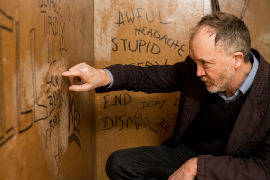
John Schofield examines the graffiti left by Sex Pistols
(linked from the University of York page)

This blog should have been written last year, around the 40th anniversary of publishing the God Save the Queen by Sex Pistols. However, at that point I had not heard John Schofield giving his talk about Sex Pistols and the archaeology related to them. Thus, I am behind my times. Actually, I am quite an archaeologist since I am talking literarily about the past, even it is contemporary past in so many levels.

Sex Pistols and archaeology did make the news – in November 2011. That was the year when Paul Graves-Brown and John Schofield published their article ‘The filth and the fury: 6 Denmark Street (London) and the Sex Pistols’ in the journal Antiquity. This article made newspapers to write all kinds of articles on their pages. First the mood was stunned but then some papers like The Guardian got the idea and did not find it infuriating. To be honest, at the beginning they were puzzled and horrified how the archaeologists could compare the drawings of John Lydon, Johnny Rotten, to the Paleolithic cave paintings but after Paul Graves-Brown wrote a piece on their pages. However, the Daily Mail could not quite forget the upset the band caused in their hayday and kept their negative tone.

In the whole saga, Historic England came out as a progressive body. The archaeology Paul Graves-Brown and John Schofield had discussed were the drawings on the wall made by John Lydon while the band was living on 6 Denmark Street, the so-called Tin Pan Alley of the music business. The drawings had been found under the wallpaper undamaged and the archaeologists got a change to record them in the nowadays backroom of a guitar shop. They managed to photograph them all in their time there. This archaeology then made one part of the reasons why the building became II* graded listed building – on the 40th anniversary of publishing the God Save the Queen. That I call being progressive. Although one has to point out that the houses in question are unusually lovely examples of the 17th century traders’ houses that have not survived elsewhere.

These events had totally passed me by until John Schofield came to Stockholm and gave a talk to them. So here you have it: old news with a contemporary twist. John Schofield wants to promote so-called ‘punk archaeology’ that similarly to punk allows all to have a say in heritage. 6 Denmark Road he and his co-author have named anti-heritage because it was anti-establishment. If I understood correctly, their intension is more to let normal people to have say what they see as their heritage than clash with the government. This sound quite a lot of the community projects different bodies have been engaged lately. We could now see crowd-sourcing and crowdfunding as punk. But how bottom-to-top is that in the current heritage climate?

Sunday, 1 January 2017

Best in 2016


The hafted axe from Must Farm
(Cambridge Archaeological Unit, linked from the BBC site)

This is the time of the year when different organisations and media outlets have been naming the most important archaeological sites or finds. When looking at Britain there is no match to Must Farm, the water-logged Bronze Age sites named a northern Pompeii. The site was destroyed in a fire and the remains that collapsed into water have revealed unexpected insights to the daily life and technology, including all the wooden details of then everyday. This site was Heritage Daily’s number 1. The number 2 went for a Swedish find, albeit in Greece. The archaeologists from the University of Gothenburg have found an unknown Greek town from Thessaly.

Must Farm was also BBC’s number 1. They also acknowledged the start of the Anthropocene from AD 1950. However, they also pointed out how human activities have influenced environment long before modern times. It is suggested that the beginning of agriculture meant that the World was warming up already then thousands of years ago, perhaps leading to an avoidance of a new Ice Age.

On the Live Science web site the list of the finds of 2016 is naturally deprived of Must Farm, being a company with a major presence in the States. They do have offices in Europe, In the UK, Germany, France and Italy, but their list if filled with the more main stream, ‘exotic’ archaeological sites, including the reopening and the study of Jesus’s tomb and new piece of the Dead Sea Scroll. They also list the youngest individual mummified in ancient Egypt, a perhaps 20 weeks old foetus in the collections of Fitzwilliam Museum in Cambridge. They also notify El Castillo pyramid at Chichén Itzá including three pyramids one above each other on the same spot ranging from c. AD 600–800 to the date just before year AD 1000.

The reality is that it is very difficult to surpass Must Farm and its hafted bronze tools and other magnificient finds. However, Must Farm is only one of the nominees for the Current Archaeology Awards 2017. You can go and vote for the innovation of the last 50 years and the book of the year among different categories, voted by the general public. In that way, you can participate in archaeology right at the beginning of 2017.

Monday, 26 December 2016

Tweeting and advocating (a TAG story)


A tribute to David Peacock

The week before Christmas is the time for the annual Theoretical Archaeology Group (TAG) meeting. This year we left it to the week before to actually decide which one of us will go to Southampton. In the end, I headed there, since I did not have any holidays left to cover the childcare and I thought that the conference and the DigiTAG 2 session there would be a good vehicle for the Computer Applications and Quantitative Methods in Archaeology (CAA) live tweeting session. After all, the DigiTAG sessions are organised in collaboration between the CAA and TAG and the first session took place in Oslo in April. This time the session was all about storytelling, ran this time as previously by James Taylor and Cara Jones, but also of the more serious business of knowledge creation.

Due to the need to be the whole day in the same session in the middle day of the conference and my interest in the Archaeology is a political matter session, I ended up hearing practically none of the random papers about the less known archaeological areas or regions that are the main feature in my usual TAG experience. There would have been a very interesting session on Following things in motion with everything from the sarsen stones from Stonehenge to how to be an Egyptian mummy in Victorian Britain as well as copper and colonialism together with druids, if all the papers took place as intended. There were the usual cancellations and overlapping papers, which meant that I could not hear the Tintagel Castle paper that was moved to a time I had to take my train.

Even if I could not hear everything, it was a TAG that gave a lot to think about. It was also an event to celebrate the 50 years of the Southampton department. This celebration took the format of a Personal Histories debate with all the big names in the panel, including Lord Colin Renfrew, Tim Champion, Mike Parker Pearson and Simon Keay. Since the admired pottery specialist David Peacock had recently died, the discussion was very polite and sober. The most colourful piece of information was Tim Champion’s acknowledgement that the Class of 1979 with Mike Parker Pearson and Tim Darvill, both in the panel, was the most competitive of all. The discussion was also guided by a PowerPoint presentation, prepared by Joshua Pollard and Andrew Jones, the organisers of the debate.

Before the debate there was Rosemary Joyce’s keynote Antiquity lecture that was given on a subject not expected by the organisers. Much of the conference was about art and visualisations – there was a Sightations art exhibition with the sessions attached as well – they had hoped to get a lecture on figurines. Instead, we all heard about nuclear landscapes. This sounded very familiar, since Cornelius Holtorf has a project on nuclear waste deposition, but Joyce’s paper gave a unique insight to the concepts behind the suggested deposition sites in America. It was all about how to make universally conveyed a message that these sites are beyond touching. It was interesting to know that archaeological sites had been used as examples of long-term preservations and the winning concept included a rectangular ‘Stonehenge’. After this double event, I and our friend Mark headed to get our complimentary glass of wine in the reception, sponsored by the Chartered Institute for Archaeologists (CIfA).


Tara in a remote mode

My live tweeting could have gone better, since I lost the signal in the middle of the session (I should not have left it to the guest Cloud service to host my tweeting), but at the beginning I was on the money. Luckily, there were others in the session who were copiously tweeting, so I could retweet the most essential content in between. The highlight of the session was Tara Copplestone’s remotely delivered paper on the Playful Past, Storytelling through Videogame Design and Development. It discussed the matter of the position of the creator in forming archaeological stories and described how the process of creating multiple videogames engaged the PhD author with the problems of coding, storytelling and archaeological process in consecutive steps during the development. The paper took form of ‘live’ doodling so it was well-executed on all levels. Naturally, it was impossible to be positive about Matthew Fitzjohn and Peta Bulmer’s LEGO creations for primary schools or be mesmerised by digital funerals by Audrey Samson. Similarly, Paul Backhouse’s presentation showed how much creativity there is in Historic England.

The next day I just marginally missed hearing a paper about Brexit. Nevertheless, the first paper I heard by Marjolijn Kok discussed openly the matter of hidden political acts in commercial contract archaeology. She was talking about Holland, but similar issues are faced anywhere where the commercial market has been embraced. The developers do not exactly want the archaeological service but take the lowest bidder and the existing theoretical environment means that the theoretical in archaeological is seen only to happen in the interpretation phase, not in the formulation of the methods and data collection. These issues and other stuff led her to leave her job – but not archaeology. Now she has been involved in contemporary archaeology in recording an Occupy camp in Rotterdam. The presentation can be looked for in academia.edu.


From Richardson and Lennox's presentation

Other highlights of the session included the discussion on public value in archaeology by Rob Lennox and the description of the experience of running the Local Heritage Engagement Network by Lorna Richardson and Rob Lennox. I know, they were the organisers of the session, but they had a lot to say. So much so that Rob’s carefully thought graphs had to be photographed in order to be appreciated later. The LHEN showed that while some campaigns did fine work, even if too late in the process, many volunteers are reluctant to act. This is partly to do with the fact that that is not why they are doing archaeology and do not see themselves as campaigners. However, local planning can be influenced only at the local level unless the policies change…

So, next year, it will be Cardiff and hubby’s turn to experience TAG and see the people we go for curry in TAG.

Monday, 12 December 2016

Christmas conference

Last week it was the time of the Department's traditional Christmas conference, an occasion to either discuss important recent issues or developments or present current research at the Department at Stockholm. This time we selected few presented our current research projects. I myself was discussing defining group identities whereas the other topics were varied both chronologically and geographically. Sadly, there were few cancellations, but I am sure we will hear about Ann-Louise Schallin's research in Greece or Magnus Enquist's ideas about evolutionary transitions at a later stage. Maybe in the next Christmas conference.

A few of the presentations were discussing the current DNA work in the laboratories. These presentations included Aikaterini Glykou's many studies on Baltic seals in the mid- and late Holocene. Her and her collaborators many methods include also DNA studies. Naturally, Anders Götherström presented the surprises from the ATLAS 1 and 2 projects and some idea were the human DNA studies are venturing at Stockholm. In addition, Maja Krewinzka presented a new and exiting project studying the multiple burials from Sigtuna. There was also a short talk on plant DNA: Matti Leino is carrying out some experimental work with charred grains. It will be interesting to see if he will succeed in pointing out the conditions where the DNA could be preserved.

A couple of talks discussed attitudes in the past. To start with, Anders Andrén presented his project on An Archaeology of Absence. This is an ongoing study on the archaeology of disappeared and non-existing Jewish communities in central Europe and Scandinavia. In his talk Arne Jarrick did not touch upon only Annalistic history writing but also gave a retrospect of his whole career as a researcher, from the starting points to the future lines of resarch. Frederik, on the other hand, told us about his project Materiella bilder for which he has just got three-year funding and in which he will try to outline past image programmes from the Bronze Age Mälare area. It was refreshing to hear about the rock carving tradition of central Sweden that is less well known than the southern Scandinavian and Norrland traditions.

Some project were site-based. Jan Storå presented his and Jan Apel's almost finished project from Gotland. Their study of the pioneer settlements show different adaptations for aquatic resources at different kinds of sites. In the other chronological end of the Swedish prehistory was the presentation of Sanby borg - a 5th century ring fort on Öland by Gunilla Eriksson. We learnt about the interesting life and death of this Iron Age site.

Geographically, the most far-flung place was Egypt. Åke Engsheden from our Section of Ancient History and Classical Archaeology was presenting his infrastructure project during which he will create a digital catalogue of Coptic ostraka. His examples presented a reminder of how the humans had very human relations even in the past. A very suited reminder when we all from different Sections of the Department got together in order to hear the diversity and variety of the archaeological research at Stockholm.

Sunday, 4 December 2016

The most materiality of all

It is again the time of the year that is the most materialistic of them all - Christmas. I was reminded this by my search for a small present for my husband. At Christmas we all embrace the materiality of things - and it is not only a negative thing, even if Christmas seems more and more commercial every year. However, in the darkness of Sweden the Christmas lights on balconies make a real difference. The many stars in the windows lighten the darkness. It is the time for candle light and the smell of Christmas trees. Suddenly, there are sellers in every suburb in Stockholm. Even in England the hubby has bought and decorated one. The family cat has only knocked it down once so far. These are the things a Christmas does not feel like Christmas. The candles, the Christmas tree, the presents.

The materiality of Christmas evokes the memory of the Christmases past and the rituals make us feel safe and content. I have spent some moments thinking about my Christmas card that will be sent through social media and its digital immateriality is a reminder of the materiality of the cards we will still send out. We have started to plan the most important of rituals: the Christmas meals. One for the Christmas Eve, one for Christmas Day and one for Boxing Day. I have already discussed the gingerbread making with my work colleagues and hope that this year's lot will be better than last year's. There is such thing as too much butter. Not to mention too much ginger and too much cardemom. Through the actions we live and relive the Christmases past and present. Through the ritual of the Christmas meals we join a long history of mid-winter feasting.

For a couple of years, even the Chrismas advertisements in the television are becoming safe rituals. There is no Christmas Calendar programme in the TV in the UK so perhaps the advertisement are the forerunners of the festivities. I have kept my eye on the Swedish and Finnish offerings and hope that something can be seen when back in the UK. The flickering Christmas lights on a computer screen.

Wednesday, 2 November 2016

Sunday night drama

I have been following with half-hearted enthusiasm the ITV series of Tutankhamun on Sunday evenings. In a way it is a perfect Sunday night costume drama with Edwardian and early 1920s costumes, the Valley of the Kings as a backdrop, and the unimaginable treasures to be found. However, the last item is the real problem, since you know from the start what is going to happen. They are going to find a royal Egyptian tomb. An intact royal Egyptian tomb. So no nail-biting suspense there then.

It took Carter and his financer Lord Carnarvon a long time to find a tomb and the First World War ended their original exploration. However, the frustration has been very politely presented to say it the least. Maybe it is the lead actor for me, since the son of Jeremy Irons does nothing to me. I find his face lacking the expression of emotional depth. This I found again quite amusing yesterday when he tried to express his mind-numbing emotion and surprise after he had found the tomb intact and good mutter that he sees ‘wonderful things’. But maybe it is just me and Max Irons is not my cup of tea.

The emotional moments where over quite quickly, whereas I as a long-term Tutankhamun admirer would probably like to have the glimpses of finds in slow motion and the actual moments of findings to last as long as possible. After all, finding the riches had taken them two and half episodes and it was all done in the space of probably five minutes. Then they were carrying the finds out of the tomb and started to record and discuss the finds with the local antiquities authorities. So the climax of the series was over very quickly considering the time before the after.

This being a Sunday night costume drama it cannot do without romance and other intrigue. We get a good idea of Carter’s love interests over many episodes and the other matters than the tomb naturally are in focus when there is four episodes to be made in flesh. Naturally, this side of affairs is less familiar with the archaeologists who have been reading different treatises of the find and are more familiar with the photographs of the find than any liaisons of the heart. I am not so familiar with the background stories that I cannot assess how much of the drama is true and how much have been hyped up.

So, the series so far is mildly interesting, pleasing to watch, filled with talented actors and actresses including the staple feature of international productions, Sam Neill as Lord Carnarvon. It has been worth watching, but I have been dipping in and out without any guilt. The result of knowing how it all ends.

Sunday, 23 October 2016

When soft is too hard

This week showed that Sweden is not the only country that needs petitions in order to save archaeology. Over the North Sea in England, the AQA exam board is culling its archaeology, classical studies and history of art A-levels. This is apparently not about money or concentrating on the hard core EBACC subjects. No, this is providing every student the best exam results they deserve. What the students deserve just do not happen to include the disciplines that tell about the development of the humans or their culture.

The reason given for the cull is that these disciplines telling the human story are complex and difficult to mark evenly. So, these disciplines that apparently belong to Gove's so-called soft subjects are so hard that they cannot be offered to the students, since it is apparently difficult to find talented markers. It is quite alarming that the cull may take away subjects that make students, teachers and markers to think, evaluate and argue. These one would imagine are skills that would benefit any students later in their life. In addition, archaeology is not just about humanities but has a lot of both practical and science content. It is something that can give something to any learner, no matter what their strengths are. That should help students to get the best exam results they deserve!

Luckily, all members of professional communities covering archaeology, classical studies and history of art have been vocal about the added value their discipline brings to the A-levels. Archaeology got Tony Robinson to tell about its significance. He called the plans to drop archaeology A-level "an assault to Britain's heritage". The Chartered Institute for Archaeologists (CIFA) came out fighting and one can sign a petition online. The plans of scrapping have been described as "barbaric acts" target="blank" and it is true that in the long run these kinds of acts may lead us to barbary of a kind, if society does not educate rounded and skillful individuals. One just have to hope that the real reason for the scrappings is not money. These are minority subjects that take money to provide and mark their 'hard' exams. If only the money talk, it is one sort of barbarism when it hits the education system.

The petition against dropping the archaeology A-level has currently over 11,500 signiture. Maybe you can add yours?

Sunday, 9 October 2016

Another autumn, another petition

It seems that drama never really leaves Swedish Classical Archaeology. This year's petition is not about any of the Swedish Mediterranean Institutes but about the Mediterranean Museum in Stockholm. The politicians are suggesting to creating a new World Culture Museum out of the Mediterranean Museum, Ethnographic Museum and East Asian Museum. This is not really about their core activities failing but a shiny exhibition space making a loss. Thus, a rescue plan that would see building of a new museum and scarily vanishing of specialist expertise in any of these museums. The new curators would not be specialist in classical cultures or China but more general topics, such as gender studies. This is not bad in itself but why have collections when you have nobody who knows what the things are? How do you educate and help research effectively? Therefore I hope this petition to reach its goal and saving the Mediterranean Museum!

Currently there are just above 900 signatures. Maybe you can add one more using the link above...?

Friday, 27 May 2016

Book reviews

I am currently on sick leave and will be until late June. I will resume my blog at a suitable moment when I feel better. In the meantime, you can read my latest book review on Walsh's Consumerism in the Ancient World in Arctos 49.

I have a recent book review in Antiquity as well, on the volume on the tribal area of the Vestini in the Samnite area.

Sunday, 24 April 2016

Galway was sunny!


Students posing and showing the poleholes of a circular residential structure

Last weekend's Conference of Italian Archaeology saw me giving two presentations and chairing the Roman session. There were a huge amount of interesting papers on funerary archaeology. There was exciting new site work from the Italian colleagues, presenting the finds from Pontecagnano, Cumae and Capua among the places mentioned most often. Naturally, I did not hear much of the southern Italian sessions, but what I heard as part of more thematic sessions, they provided interesting novelties from all over. Nevertheless, settlement archaeology was not totally forgotten and the large Dutch Crustumerium project presented their latest finds by Peter Attema.

Highlights were so many they are almost impossible to present, but Phil Perkins did the first presentation of the new Etruscan inscription of Poggio Colla, a site where he collaborates with the American field school of the Mugello Valley Archaeological Project. The find was beautifully presented in press coverage, such as the Archaeology magazine. This find came from a secondary setting, incorporated in a wall, and its meaning may remain uncertain, although scholars are working on it as we speak.


Indegenous metal object from Megara Hyblea

The Have you said métissage, acculturazione or hybridization? session brought together French and Italian archaeologists and anthropologists among others. One of the highlights came from the École Francaise, when Reine+Marie Bérard presented the few indigenous finds from the necropolis of Megara Hyblaea. The finds of indigenous metal objects came from the children. She assumed that the children could present mixed identities, while the potentially indegenous mothers may have had to follow the Greek rite for religious reasons. In this session Pithekoussai and its international community was presented, too. Valentino Nizzo on Constructing Deathscapes presented also a thorough review of different theoretical approaches while was one of the most interesting presenting mixed communities.


Nizzo on Pithekoussai

Elsewhere Sarah Willemsen and Tanja van Loon presented how radical reform of ritual practice, when people moved away from wine mixing and banquet vessels to nothing. The connection to drinking and libation rituals and different kinds of feasting changed. Anna Rita Russo's presentation of aes rude from tombs of Pontecagnano showed how the weights relate to monetisation of Italic tombs while the finds relate to hands and double pots.

One of the most touching moments was the session to celebrate John Wilkinson's and Ruth Whitehouse's work. Their former colleagues remembered their contribution to the Accordia Research Institute and Ruth's students Carrie Murray and Lucy Shipley brought gender views prominently into the session.

However, now back to recuperate and more the next time...

PS. I did forgot to thank Eóin O'Donoghue who was delightful and helpful all the way. No rainy day - even if there were clouds.

Sunday, 10 April 2016

Space Archaeologist and History Guy do the Vikings


The main team at the site (image linked from the Guardian web site, Freddie Clare/BBC)

Some time ago I wrote a TV review on Space Archaeologist’s and Dan Snow’s, aka History Guy's, programme on the Roman Empire. I had wanted to like the programme, but there were aspects that seemed to make the narrative simplistic, basically simplifying archaeology and hyping up the findings and methods. Last week’s programme on the Vikings, the Vikings Uncovered on BBC1, even if it was much more balanced and improved from the Roman offering, still had some of the formulaic TV speech that does not make archaeologists happy: everything significant is named as ‘clues’ and different uncertainties or facts or hypotheses or conclusions are repeated and repeated and repeated again and again. I cannot remember, if ‘mysterious’ featured. The programme also seemed to enforce the perception that archaeology programmes on BBC are predominantly headed by non-archaeologists, albeit people working in the related fields (e.g. Dan Snow, a historian, and Professor Alice Roberts, originally a medical doctor and lecturer in human anatomy, in Digging for Britain). However, Space Archaeologist is an archaeologist with a PhD in archaeology and the advisors included Dr Karen Milek, an expert in scientific study and fieldwork across Scandinavian Viking world and its archaeology.

Nevertheless, Dan Snow’s round tour of Britain was illuminating and Space Archaeologist’s search for differences in vegetation in the treeless turfed landscapes of Iceland and Newfoundland was methodologically rooted and developed further in the methodology of archaeological remote sensing. It is just the way she appeared in the programme to turn up without any preparations or reading, totally relying on experts on evaluating all aspects of northern Atlantic archaeology. There is wide literature on all matters Viking, also in other languages than the Scandinavian ones, one could turn to. In a way this reliance on experts was an improvement from the programme on the Roman Empire, where she was presented as an expert on every method possible, able to point out relevant features anywhere in the Mediterranean. However, now the emphasis seemed to veer slightly to the other extreme, not showing that a scholar can accumulate knowledge by reading and examining collections, even if it be said that it is safer to ask people with decades of experience of local geology and material culture – as the scientific analysis of some supposed iron slag and a rivet or nail showed. The team had excavated a stone and a piece of natural ore instead of definite evidence in Newfoundland. It was also nice that she showed that the research is a team effort at Birmingham in the States, so that she complements her strengths with those of the others.

The programme did omit some crucial facts that had emerged after they had finished filming. Not adding a voice over or a text board at the end of the programme on the new exciting facts gave an appearance that the team based their conclusions on the biased use of evidence. During the programme Space Archaeologist was developing through trial and error a way to observe potential Early Medieval turf-walled houses from space. The vegetation seems to thrive were the cut turf quadrangulars have been piled in the past and they have then turned into a soil having microlayers of mineral soil or, in the case of Iceland, volcanic ash improving the growth conditions. In Newfoundland the site had signs of fire and carbon samples had been gathered. The dating results shown in the programme seemed to date the place in the 17th century, but these were dismissed outright due to suspected contamination problems. Considering the evidence showing only heating natural ore at some point, this gave an idea that the makers wanted and accepted only one answer. Only by following the hashtag #VikingsUncovered Twitter feed the following day, I realised that they had received a series of results dating to the 9th century and slightly later afterwards. This omission left the archaeologists watching the TV show with a wrong impression – even if in the end the team had proven the Viking Age activities. Not all read the details of the pre-show press releases, since news about a ‘potentially important new Viking site in Newfoundland’ was circulating across social media some days before.

Even if The Vikings Uncovered was highly interesting, it was also slightly too long. Even if the best parts were the visits to the earlier excavated sites in Britain and L'Anse aux Meadows in America together with the delightful experts in Iceland, the slightly ‘Famous Four’ styled search for the Viking turf long houses dragged on and on. Again there were some slight comedy TV moments, when certain activities were performed for the camera. Naturally, jeeps were involved crossing beautiful landscapes and the camera followed a speed boat taking Sarah around the islands. In Newfoundland Dan Snow allegedly trekked for an hour to Sarah Parcak's excavation site. He had a crisp blue shirt, seemingly empty rucksack and brand new trekking shoes. He did walk into every puddle on the short trek he was shown to do. He paid absolutely no attention where he was walking. In real situation, his shoes had been flooded with steps one and two and the hour’s trek had been very inconvenient in the end. When he happily arrived to the small dig site, he seemed to have had no discomfort...

Finding new Viking sites in America is exciting by default, but the best parts from my point of view were those telling about the major sites in Britain. The digital visualisations of the Viking York, for example, were amazing. The stories such as the crushed skull in the Portmahomack monastery in Scotland, the major monastic centre of the Picts, showing clear sword cuts, featuring the interview of Professor Martin Carver, the excavator of the site and Sutton Hoo as well, really educated the viewer about the very limited evidence for the Viking raids. Similarly, the funerary evidence from the Viking Repton at St Wystan’s Church in Derbyshire was astonishing. The remains of entangled skeletons, making a reference to the burial, historically believed to have been one of a giant warrior, told a truly fascinating story of a war lord at death. There was slightly a sense that two programmes – one on the Vikings in northwestern Europe and one on the search for the turf long houses, both deserving a fair independent and intelligent presentation – were trapped in one maxi episode.

It was interesting to recognise an aesthetic style featuring nowadays in many of these big archaeology productions: archaeologists seem to be moonlighting as secret agents, working in dark basements for SPECTRE or some other mysterious organisations. Archaeologists sit with laptops at very small tables with one spotlight illuminating their tiny workspace. The spotlights light presenters’ faces in obtuse angles in the shade where they tell of scientific finds. It is all made for TV, but the simultaneous glorification and dumbing down leaves an archaeologist feeling a bit short-changed. This material – and the talented archaeologists and historians - were worthy of so much better treatment across two programmes. What a programme BBC4 had made out of this material. The kind of headed by Joanne Fletcher or Lucy Worsley – or more fittingly Nina Ramirez. As an archaeologist, one has a very specific view, perhaps even too critical, and thus, one is left wondering, if the Joe Public really enjoys the hype over a humorous, but informative and non-repetitive narrative.

Sunday, 3 April 2016

Palmyra recaptured: doom or hope?


Temple of Bel before and after
(linked from the Mashable web site, original Joseph Eid/AFP/Getty Images)

I was going to write this blog post about Florence and its marvellous archaeological museums, but once again, the real life events have meant that I have to postpone the cavalcade of beautiful photos and discussion of Italian input into different fields of archaeology to another day. Suddenly, Palmyra is 'free' again. Considering the social media and newspaper output, there is about two general lines of taking this news. Either we lament the lost treasures, which were many - and we do not yet know how many archaeological sites within were plundered and robbed - or we celebrate what is left. No matter how reconstructed it may be.


Not Florence, yet

I can declare from the start my point of view: I hope that we can take a hopeful view in the long term. Yes, there are heartbreaking destruction and two main temples are no more. However, the site still exists and now it will stand for resilience against parties that do not have respect towards the achievements of others or value of a shared history but only can prosper when bringing destruction and sufferance to others who do not share their specific point of view. The stones are still there - and we may be able to see the destruction as a monument to other people's care and ultimate sacrifice, pride and preservation of our common heritage. I am more shaken of the news of displacement, cruelty and pointless deaths in the desert.


Our shared heritage in the southern Mediterranean

However, what the future brings is still unclear. As it has been pointed out, the 'liberators' may not have always been such 'preservers' as they may now hope to be seen. We have broken countries, looted tombs, broken people and human sufferance that does not currently have an end date. The modern Palmyra is a ghost town, the bombed shells of houses standing as they do in Aleppo and other scenes of battle. When we can recapture personally Palmyra and other sites of world heritage across Syria and Iraq we do not know. The mapping of archaeology, the historic photo collections, the virtual reconstructions - there are many routes people have already taken and the destruction has woken a community. There may be more doom on the cards, but I see signs of hope.


The destruction in the Palmyra Museum is apparent from The Guardian.
The drone footage shows what is standing.
The before and after images are not a pretty sight.

Sunday, 27 March 2016

RACed and TRACed? Part 2


The cast gallery at Sapienza University

Are RAC and TRAC different? One assumes that the first is for established professors, and so it sometimes was in Rome, and the latter is for new currents in recent research, organised by PhD students, postgraduates and early career researchers. On paper part of the programme was so: there were Mediterranean-wide topics on ports and trade in sessions organised by illustrious professors and researchers and other overview sessions describing research over Roman Britain, Dacia (more or less modern Romania) and Lusitania (Portugal) in the RAC, where as in the TRAC sessions discussed for example Marxism and gender. There was also Session 1 in the RAC that introduced the new research initiative to bring the materials from the Pontine area, Tiber valley and suburbium all together in collaboration between the University of Groningen, Sapienza University and the British School at Rome. However, in places, it was impossible to say outright which conference you were sitting in. Considering contemporaneity of the themes, the sessions on Sensing Rome and that on Urban Streets as Communication Spaces could have been in the TRAC as well.

My conference started with supporting my fellow Swedes and listening the first two papers in the Beyond the Romans: what can posthumanism do for classical studies in a disappointingly sparsely attended session (to start with). Irene Seisvold (University of Gothenburg) outlined the general themes in posthumanism, emphasising human’s place only as one of the historical actors and agents on the planet. Linnea Åshede (University of Gothenburg) gave the first case study with a talk on Priapus figures. She emphasised the relations between art and viewers and the qualities the works stand for. She stated that the most important point in time is during encounters when different identities and agencies meet and create actors and cause effects. They prompt people to position themselves – both in the past and present.


Landeschi in the Sensing session

From posthumanism to Interdisciplinary approaches to ancient Roman diets. Among the talks I heard the most interesting and thought provoking was Emily Holt’s presentation (SUN Buffalo/Museum national d’Histoire Naturelle) on ‘Animal consumption: social inequality and economic change in a non-elite area of Pompeii’. The results from the Porta Stabia project did show how the nutrition changed over time. Holt wanted to know if the economic growth of the Early Imperial times had positive effects on food consumption of the average Pompeians. Her research methods included traditional bone figures, micro remains from flotations and SEM-identified egg shells. Her results were mixed. On one hand the lower class Pompeians got more and better meat from younger animals, but the cuts were poorer. Marrow provided calories (which she took as a good thing, even if I do think remembering that within the Victorian times bone samples, evidence of eating marrow shows deprivation) and pigs were the preferred eaten species. She interpreted this mixed bag of results as a sign that more meat was on offer, people could afford cheap bits, but the selection was limited and they were priced out from buyng meatier and plumper cuts.

From inequality to Marxism. Some of the later papers apparently left people wondering where the Marxism was, but the session started with a more traditional note with Steve Roskams (University of York). He made it clear from the start that he believes that mode of production is defined as a way the elite sustains itself. However, his presentation was a historiography of different approaches to modes of production in economic history of the Roman Empire and his own review of the attitude towards social relations. Interestingly, he reviewed Greene and Aubert ducking the issue. In practice, he seemed to be advocating historical materialism as a tool of analysis of social relations and viewing change as dialectical process, i.e. how social contradictions, consequences of inequality and conflicts were resolved or not resolved in the past. The two following papers had the interesting premises and some interesting interpretations on variations and multivocality of eastern European Marxism (Emily Hanscam, Durham) and how in the DDR classical archaeology was perceived as bourgoise and could live in the form of economic history (Paul Pasieka, DAI, Rome). Pasienka also gave an overview of Italian Marxist archaeology that he buried ca. 1992 with the demise of Dialoghi d’Archeologia. Both suffered from the poor acoustics of Aula III that did not enhance presentations read from paper.


Veitch’s aural GIS maps

My personal highlight of the conferences was the TRAC session Method matters that emphasised archaeological methods in constructing historical narratives in Roman colonisation studies. The big idea of the Leiden School of field survey interpretation is emphasising vici, i.e. the larger rural settlements, villages, and their importance instead of standard independent colonist farms in local settlement patterns during the early colonial period. It is interesting how persistent the idea of nucleated village is in central and southern Europe. In northern Europe a dispersed village is a norm during the historical times (as are free peasants), so I have advocated the dispersed village model since my PhD. In early urbanisation in central Italy, though, but different settlement models should be revisited clearly more. Damjan Donev’s talk on interior Balkan areas was interesting, but it was Anita Casarotto’s presentation (with Pelgrom and Stek) that compared the legacy data from Venusia, Aesernia and Cosa that really got me going. Point density analysis suggests that southern areas were different with more clustering. Jesús Garcia Sánchez in his exciting talk was comparing functional distributions of pottery and different architectural ceramic materials. It is nice to know that not only our ceramiscene, as also presented in Rajala and Mills's poster in the RAC, highlights the ways survey material can be used further. However, in addition, he compared these distributions to geophysics, especially resistivity. His results seemed to go together. It was interesting to see a cleaning take to surveying areas where vegetation covers the surface: scrape the grass off from a systematic point sampling area.

Intertwining with Session 1 I was dropping in and out from Beyond hybridity and codeswitching TRAC session discussing new approaches to the Late Hellenistic archaeology. Raffaella Da Vela’s (Universität Bonn) gave a very interesting case study of studying cultural identities with Social Network Analysis (SNA). It was fascinating to see how density, centrality and clustering changed from period to another. Later in the session there was an interesting talk from Claudia Widow (also Bonn) about Samnite brick stamps and coin hoards. I chatted with her later in the conference and it turned out that she was actually studying the architecture of the temple sites. Nevertheless, the origins of the coins tell something – if not about the origins of the audience, then about the contacts along the line.


Children and houses

On Friday, my favourites where the Sensing Rome and Urban Streets sessions. Naturally, I enjoyed giving my talk – especially when the audience increased by the door. The strike action in the morning affecting public transport delayed many people. Luckily, I had to come during the guaranteed rush hour traffic earlier. With only 20 minutes to use, I decided to give an outline of my theoretical model and some key points from interpreting inscriptions and funerary architecture in my study area across central Italy across the chronological disciplinary boundary between Etruscology and Roman archaeology. I missed the early Sensing session due to my own talk, which I had apologised in advance to Eleanor Betts, but got a short summary from my Finnish colleagues in the audience. Even if I do like the Pompeian tabernae and Giacomo Landeschi is my colleague in Sweden and does brilliant 3D work, this time around my favourite was Jeffrey Veitch’s (University of Kent) talk ‘Structure of Noise’ presented a kind of acoustic GIS maps of the decibel levels across rooms and spaces in Ostian houses that showed something new about the interplay between sounds, architectural elements and building materials.


Simelius on peristyles

Anette Haug's and Philipp Kobusch'sStreets provided us with ideas about looking for children and their possibilities in mobility and interaction in Pompeii (Ray Laurence, Kent), discussion about Bourdieu’s habitus in different types of inscriptions (Peter Keegan, Macquarie) and election notices and graffiti hotspots in Pompeii and the importance of larger private houses plus secluded spots in the case of graffiti (Eeva-Maria Viitanen, Helsinki). Which reminds me that I did not say anything about Samuli Simelius’s (University of Helsinki) peristyle talk. Well, it was interesting, but more interesting was his comment in the Villa Lante residents’ kitchen before leaving from Rome: “I feel I may have caught something, a conference cold”. Yes, I did, too, but it became a ‘back from Sweden to UK’ cold. Sigh – where people come together, there is a cold. Leicester, the most diverse city in UK, my home town, is also the home for more variety in cold bugs than anywhere else in the country. Thus, beautiful minds from all over came together in Rome, discussed and had lunched and dined – and Leicester got one bug more.


I apologise all my readers for my failure to have pictures of female speakers this time. In some cases, I just did not think about it, I was dealing with the initial net connection, the battery was flattish or I was unsure if I had a permission to photograph and in one case the photo I had uploaded to social media was commented in a way that I thought it may be better that I do not plaster it here. The all male panel was not intended (I am sure you have heard this excuse before).

Sunday, 20 March 2016

RACed and TRACed? Part 1


Reconstruction of Portus as presented by S. Keay during the key note talk

The Portus trip at the very end of the Roman Archaeology Conference in Rome went more or less pear-shaped from my part, but otherwise I enjoyed Rome in March as one could be expected to. I was suggested in beforehand that a conference this big may be irritating and tiresome, but even if I missed some talks due to people dropping out and the schedules being tinkered at the spot, the general feeling was as sunny as the weather outside on most days. The real problem, and really down to myself, was being at Sapienza University at time early in the morning. This in turn turned me into an old lady by Friday evening, so instead of any Mostra opening or TRAC party, I and my colleague Eeva-Maria Viitanen who had her talk last in the conference on Saturday as one of the handful delegates, we headed for a quiet dinner near Doria Pamphilia.


Well deserved thanks to Chiara Maria Marchetti

Generally, the conference was well-organised and the things that went slightly awry were nothing in comparison with one truly chaotic conference I have attended in the past. All the rooms had functioning laptops and projectors, there were plenty of nice students to help us and the conference secretary Chiara Maria Marchetti was an ever-present fixture everywhere. Things got sorted promptly without delay. The poster session advice however changed along the way and there could have been signs on the walls to guide the delegates to the right lecture rooms, not only in the conference booklet. At the beginning I was a bit out of my breath – mainly because I came to Rome after a quick detour to Florence – but the coffee breaks and lunches were served also in the Museum of Classical Archaeology among the casts of the statues, which gave grandeur to the proceedings. It took a couple of hours to get going and by picking up interesting lectures and themes from both the RAC and TRAC I created a versatile programme.


The book stalls among the cast collection

There were even special effects. In the Sensing Rome session the air conditioning in the Odeon was working on overtime and my choice of short-sleeved dress for my presentation day meant that I was quite cold before it was all over. There would have been a possibility to Hoff one session for being an all-male panel, but considering who were present, I decided that it was more important to bring in a female voice by making a relevant question and take part in discussion in Italian; I did get a very good answer. In general, there were plenty of female organisers – as in the Urban Streets session where Eeva-Maria was speaking – and there was a whole session for Sex, Gender and Family (see the session list).


The end is nigh at RAC/TRAC2016

Most importantly, in the opening address the Superintendency in Rome was thanked for our free access to some sites and we were reminded of the challenging times for heritage management in Italy. We were also reminded of the struggle many of our colleagues are having and there was a wish that the loss of colleagues that stood for their heritage was not for vain. This was nice to hear, especially since my colleague was just telling in social media the story of a female colleague that had to leave everything behind and flee for her safety.

The delightfully cheap conference dinner was an enjoyable treat, spent discussing with Peter Attema from Groningen and Simon Malmberg from Bergen. It turned out that the latter was very familiar with my research, as he himself suggested. He had been in the panel that had evaluated the candidates for a Mediterranean lectureship at Oslo and he was suggesting that my research was impressive. He also shared a taxi back to Gianicolo after a nice evening.

My Friday was busy, since I was live tweeting all afternoon, not only presenting in the morning – and we were literally running a chair-it-yourself session. The first speaker was a real star and started promptly on time and finished in a similar manner while giving a good talk on Urban Structure in the Graeco-Roman world. He even loaned me his watch, so I could time my talk. With his help and little assistance from the nice students, I managed to finish on the spot and hand the turn to the Vindolanda talk. As my friend suggested, we could have been pouring our content to the listeners without any regard, but we were very civilised.

I will come back to some of the highlights I heard in the Part 2 of my conference posts. I will also come back to the Archaeological Museum in Florence when I have a slot in my weekly blog.


Rome in March

You know, it was fun. The enjoyment was increased by being able to eat breakfast on the sunny mornings on the terrace looking at Rome at our feet. I am lodging next door to emerita Margareta Steinby who has every now and then commented delightfully the everyday happenings we have faced. Now I just hope for uneventful travel.